
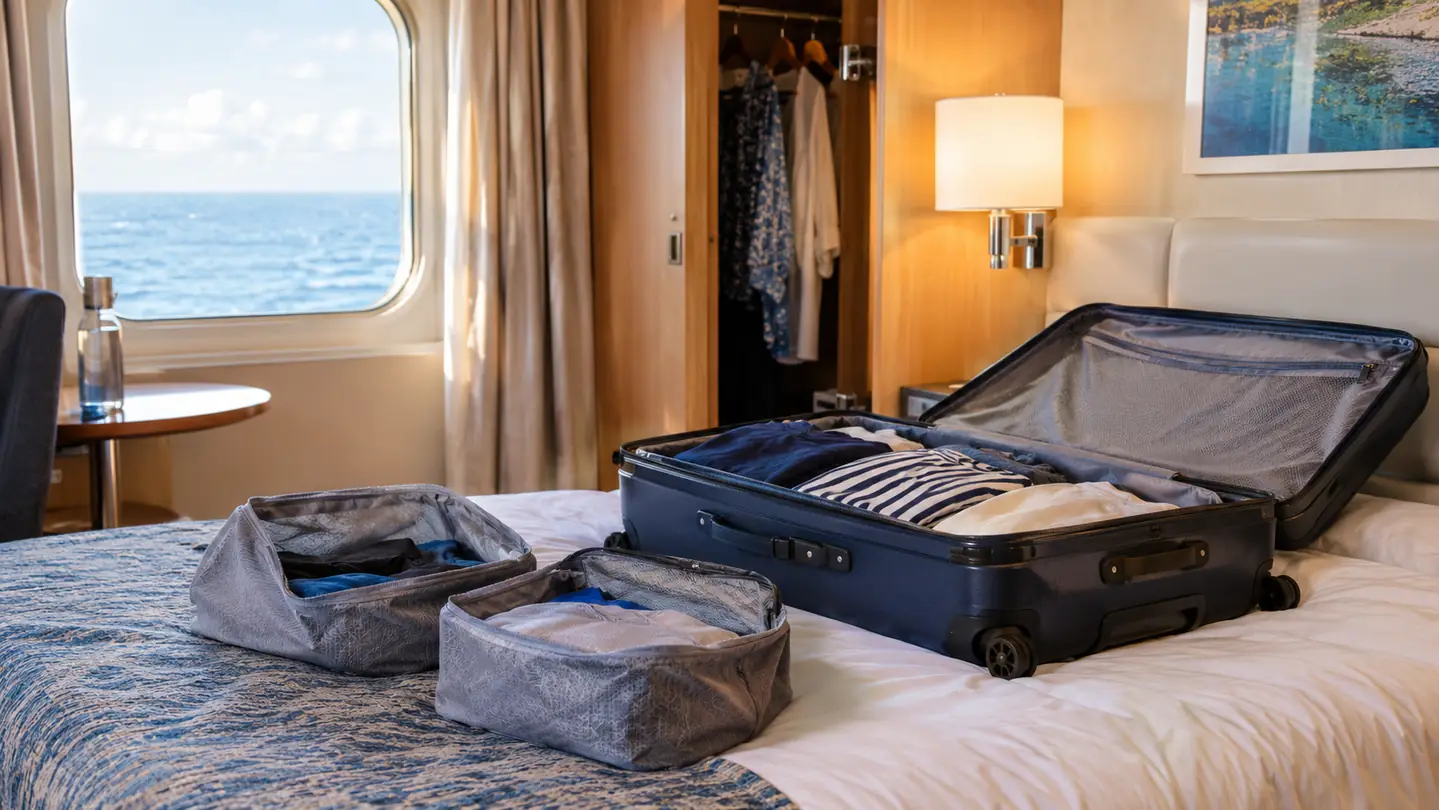
Packing for a cruise is not the same job as packing for a road trip, and the difference is not the swimsuit. It is the cabin. An interior cabin gives you a closet about the width of a dishwasher, three shallow drawers, one shelf, and floor space you will trip over if you leave a suitcase open. Everything you carry on board has to live in that space for a week, then come back out in a shape you can wheel off the ship before breakfast. My husband Gus and I have done this fourteen times since 2009, mostly four and seven night Caribbean sailings out of Port Canaveral, and we still book the small cabin that makes it hardest.
For eleven of those cruises I packed the way most people do: a stack of clothes in the suitcase, a plastic bag for the dirty things, and a small prayer at the security line. Then before our twelfth sailing I bought the BAGAIL eight set packing cubes and split the set across both of our suitcases. Three cruises later I would not go back. Not because the cubes are clever. Because they turn a thirty minute excavation on day one into a ten minute job, and because Gus can find his own shirts without emptying my side of the closet onto the bed.
Eight cubes, two suitcases, ten minutes to unpack instead of thirty
The set I bought before our twelfth sailing and have used on three since. One cube per person, one for swimwear, one for formal night, and the rest go to shoes, socks and cables.
Amazon Check Today's Price on Amazon →Step 1: Lay everything out, then take a third of it back
Do this on the guest bed at home, not on the floor of the cabin. I pull out everything I think I want, then I count the actual days. A seven night sailing with two formal nights and three port days does not need nine tops. It needs five, one of which can go to dinner with a different pair of trousers. The biggest packing mistake is not forgetting something. It is bringing three extra of something and having nowhere to put it for a week.
The other thing to settle at this stage is what the ship will do for you. Most mainstream lines run a laundry special mid cruise, and nearly every cabin has a retractable clothesline in the shower. If I know the laundry bag is coming on day four, I pack four days of underwear instead of seven. That is roughly a third of my drawer space back, before I have opened a single cube.
For our Alaska sailing out of Seattle in 2019 I ignored my own rule and packed for two climates. That trip taught me the layer version of the same lesson. A base layer, a fleece and a rain shell do the work of three separate outfits, and they roll into less space than one thick sweater. I also brought a formal outfit I never wore, because the dress code softened on the colder itinerary and nobody looked twice at a clean collared shirt. That unused dress sat on my shelf for seven days doing nothing, which is exactly the kind of thing this step exists to catch.
Gus has a different approach to this step, which is to say he does not have one. So I lay his clothes out too, and he stands there and says yes or no to each item. It takes fifteen minutes and it prevents an argument at sea, which is worth more than the fifteen minutes.
Step 2: Give each person one cube, then give the trip two specialty cubes
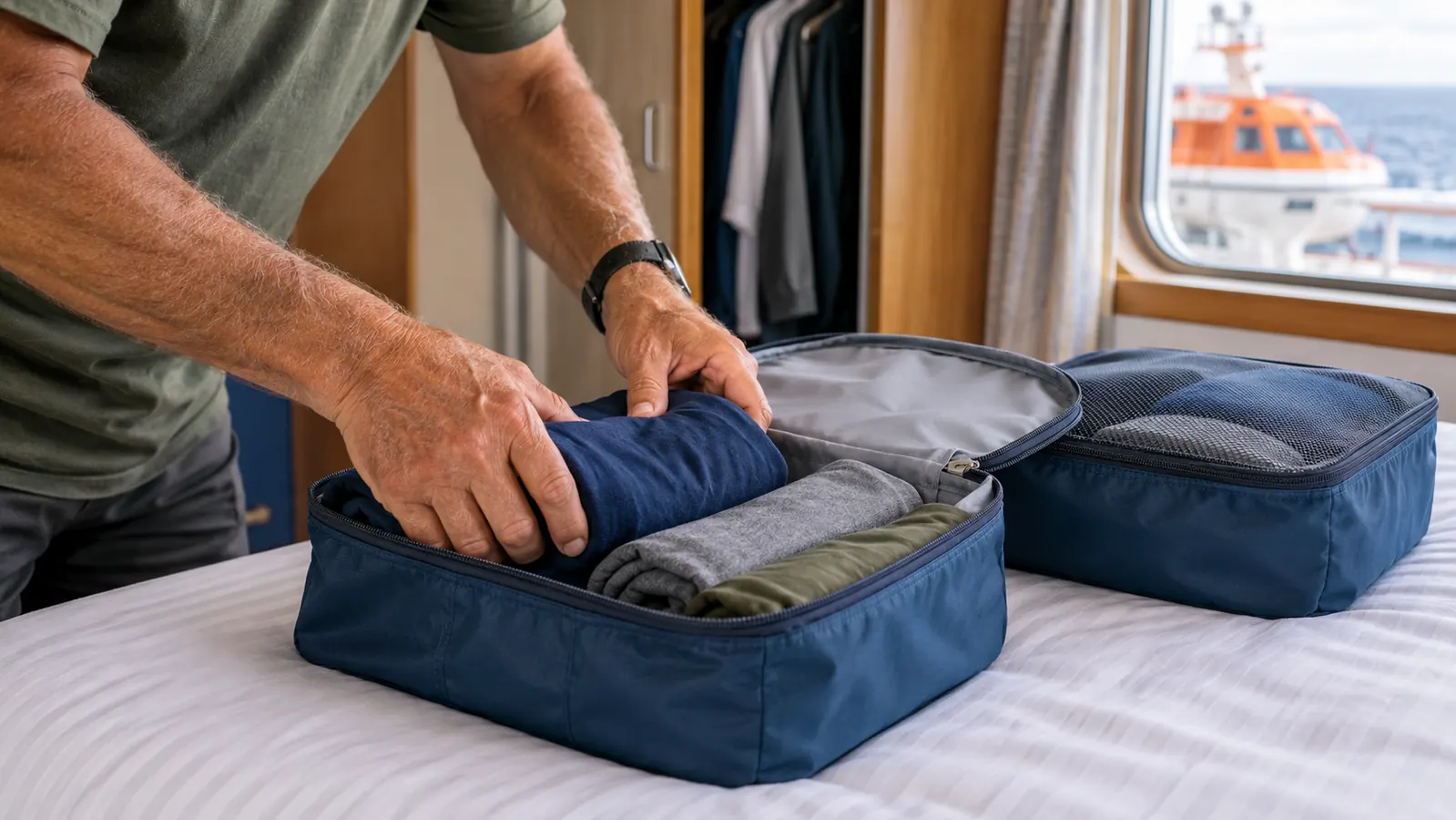
The BAGAIL set comes with eight pieces in several sizes, and after three sailings I have a split I trust. Gus takes the largest cube for his clothes. I take the second largest. A medium one becomes the swimwear and pool cube, holding swimsuits, a cover up, goggles and the waterproof phone pouch. A smaller one becomes the formal night cube: my dress, my jewellery roll, Gus's collared shirt, his tie, and his good shoes wrapped in a cloth. The remaining pieces take socks and unders, chargers and cables, and shoes.
Sorting by garment type instead of by person is the mistake I made on an early cruise. It sounds organized. In practice it means the person who wants a clean shirt has to open a cube that belongs to nobody and dig through both wardrobes to find it. One cube per person means a grown man can locate his own trousers on a moving ship without asking for help.
Two details about the cubes themselves that matter at sea. The fabric is a lightweight polyester with a water resistant finish, so a spilled drink by the pool does not soak through to the clothes underneath. And the double zipper with the extended cord pulls easily even when a cube is full, which is more than I can say for the toiletry bag I bought in 2011 and still complain about.
Step 3: Roll the soft things, fold the stiff things, and load the suitcase heavy end down
Inside a cube I roll t shirts, shorts, nightwear and swimsuits. Rolling lets me see everything at once when the cube is open, and it keeps a crease from setting in a hard line across the middle of a shirt. Anything with a collar or a seam down the front gets folded flat. The formal night cube is the only one where wrinkles genuinely matter, so it travels on top of the pile.
In the suitcase, heavy goes low and near the wheels. Shoes in a cloth bag at the bottom of the spinner, then Gus's cube, then mine, then the soft cubes around the edges. The listing rates these for ten pounds of load apiece and I have never come close, mostly because I stop the moment the zipper starts to argue. A cube stuffed to bursting is no better than a loose pile, and it will not slide into a cabin drawer.
My first cruise, in 2009, I folded everything flat and stacked it. By day three the stack had collapsed into a slope and every shirt underneath had a crease pressed down the middle from the weight above it. Rolling fixed that, and it changed how I read a cube. I can open one on the bed, see every option at once, and close it again without disturbing anything I decided against. The one thing I still fold flat is Gus's collared shirt, and I lay it in last so it sits on top with nothing pressing on it.
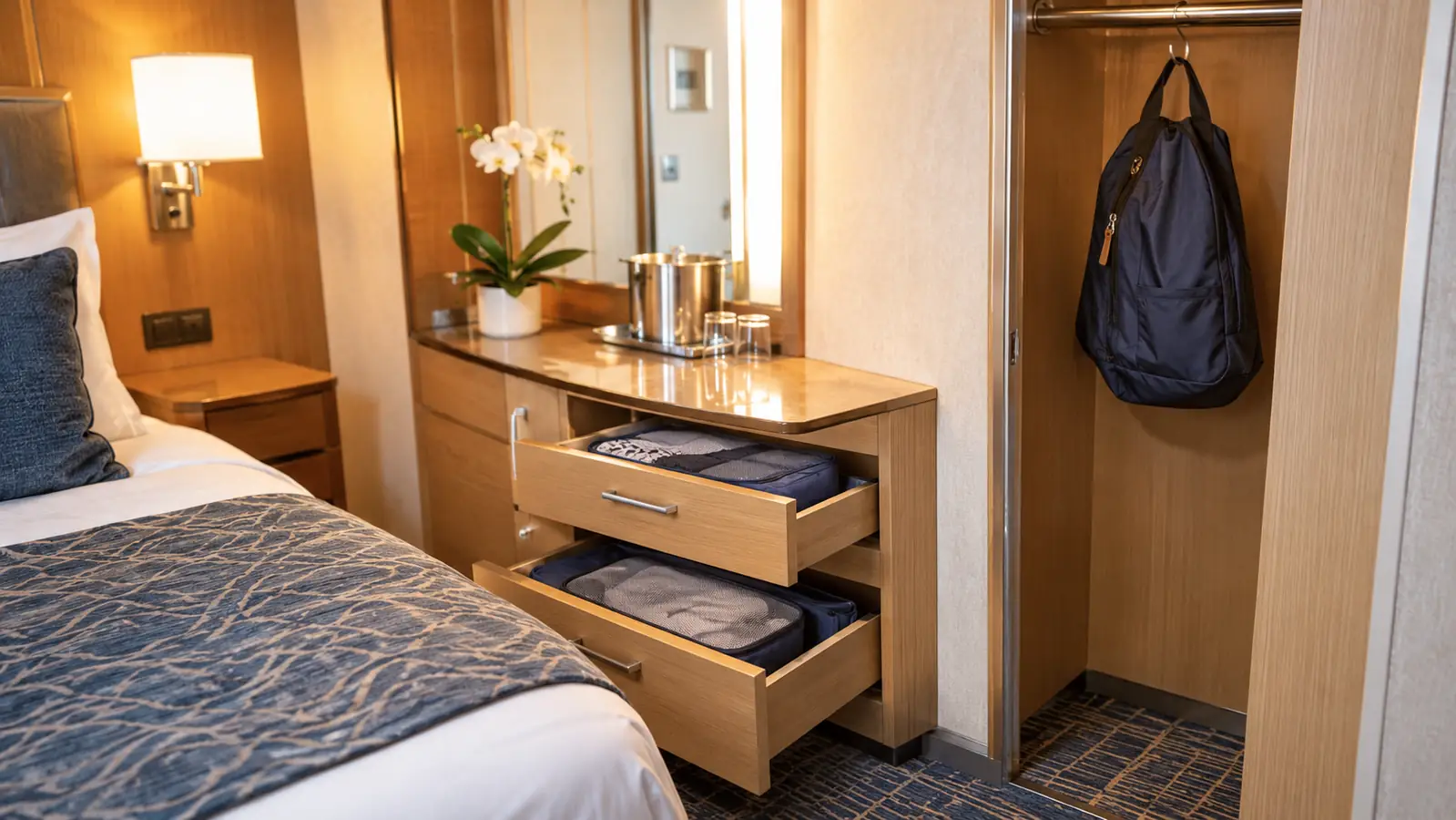
That is the warning I learned the annoying way. The drawers in an interior cabin are shallow. These cubes are listed at 12 inches by 11 inches by 4.7 inches, and if I stay under that they fit two to a drawer. Four cubes go into two drawers, the shelf takes the rest, and the empty suitcase folds flat under the bed.
Step 4: Pack the embarkation tote as if it were a separate trip
Your checked suitcases will not reach the cabin until late afternoon, sometimes after dinner, and the cabin itself is often not ready until early afternoon. So the tote I carry on has to cover the hours in between plus the first night. Into it goes a small cube with a swimsuit, a cover up and one full change of clothes for each of us, plus medication in the original bottles, sunglasses, a paperback, and the printed boarding documents.
Two things earn a permanent place in that bag. The JOTO waterproof pouch, because the pool deck on embarkation day is exactly where a phone gets splashed. And a single folder holding the passports, the boarding passes and the luggage tags, because shuffling three loose sheets of paper in a crowded terminal is how people lose them.
On our most recent sailing out of Port Canaveral we were on board a little after noon and the cabin was not ready until half past one. That is ninety minutes in a terminal and then on a pool deck with nothing but a tote, and it is the longest ninety minutes of the week if you have packed for it badly. The change of clothes in the small cube meant we could swim first and eat lunch without ever going back to the cabin, and the folder meant we cleared security without stopping to dig for anything.
The tote is packed the same way every trip, so I do not have to think about it. That is the whole point of a system. The thinking happens once, at home, and the rest of the week is just following it.
Step 5: Unpack in ten minutes on day one, then repack on the last night
This is where the cubes earn their space. I open the suitcase, lift each cube out by its handle, and set the whole cube into a drawer or on the shelf. No folding, no sorting, no stacking clothes on a bed that is barely wider than I am. Ten minutes and the suitcase is empty and stowed. On our first cruise, day one was an hour of shoving things onto shelves and still not finding the sunscreen.
Our cabin on the most recent sailing had three drawers under the desk and one shelf above the closet rail. Four cubes went into two drawers, the formal night cube went on the shelf, and the shoe cube stayed in the suitcase under the bed where it belonged. I timed the unpack that day because I wanted to know whether the routine was genuinely faster or whether it only felt faster. It was genuinely faster.
The last night is the reverse, and it is the part nobody plans for. Dirty clothes go into one cube, clean clothes into another, and the formal night outfit goes back into its own so it does not wrinkle under a pile. Because everything has a home, I can tell at a glance whether a charger or a pair of sandals is still in the bathroom. Across three sailings with these cubes I have come home with everything I brought.
One habit worth borrowing: the cube that held swimwear on the way out becomes the dirty laundry cube on the way home. It keeps damp things away from everything else, which matters more than you would guess when you are zipping up at six in the morning with the air conditioning already off.
What Else Helps
The cubes solve the clothes. They do not solve the cabin, and a few small things have earned a spot beside them. Magnetic hooks stick to the cabin walls and ceiling because those walls are steel: two by the door for lanyards and hats, two in the bathroom for a wet swimsuit and a toiletry bag, one by the bed for my glasses case. A non surge power strip with two USB and three AC outlets lives on the desk, because a cabin usually has one or two outlets and both phones, my e-reader and Gus's razor need charging overnight. Never plug anything that heats, like a curling iron or an iron, into it. That is a banned appliance on every line I have sailed.
If the problem is your stomach rather than your wardrobe, Gus wears Sea-Band wristbands on the rough days. He puts them on the night before embarkation and finds they take the edge off. They are not a cure and they are not medicine, and anyone with real seasickness should talk to a doctor or visit the ship's medical centre rather than take advice from a stranger on the internet. I do not use them, because I am the lucky one in this marriage.
Ten minutes to unpack, and for the first time in fourteen cruises nothing lived at the bottom of a suitcase for a week.
If you change one thing about how you pack for a cruise, change this
I bought the BAGAIL set before our twelfth sailing and have used it on three since. Start with the cubes. The hooks and the power strip can wait for the next trip.
Amazon Check Today's Price on Amazon →