
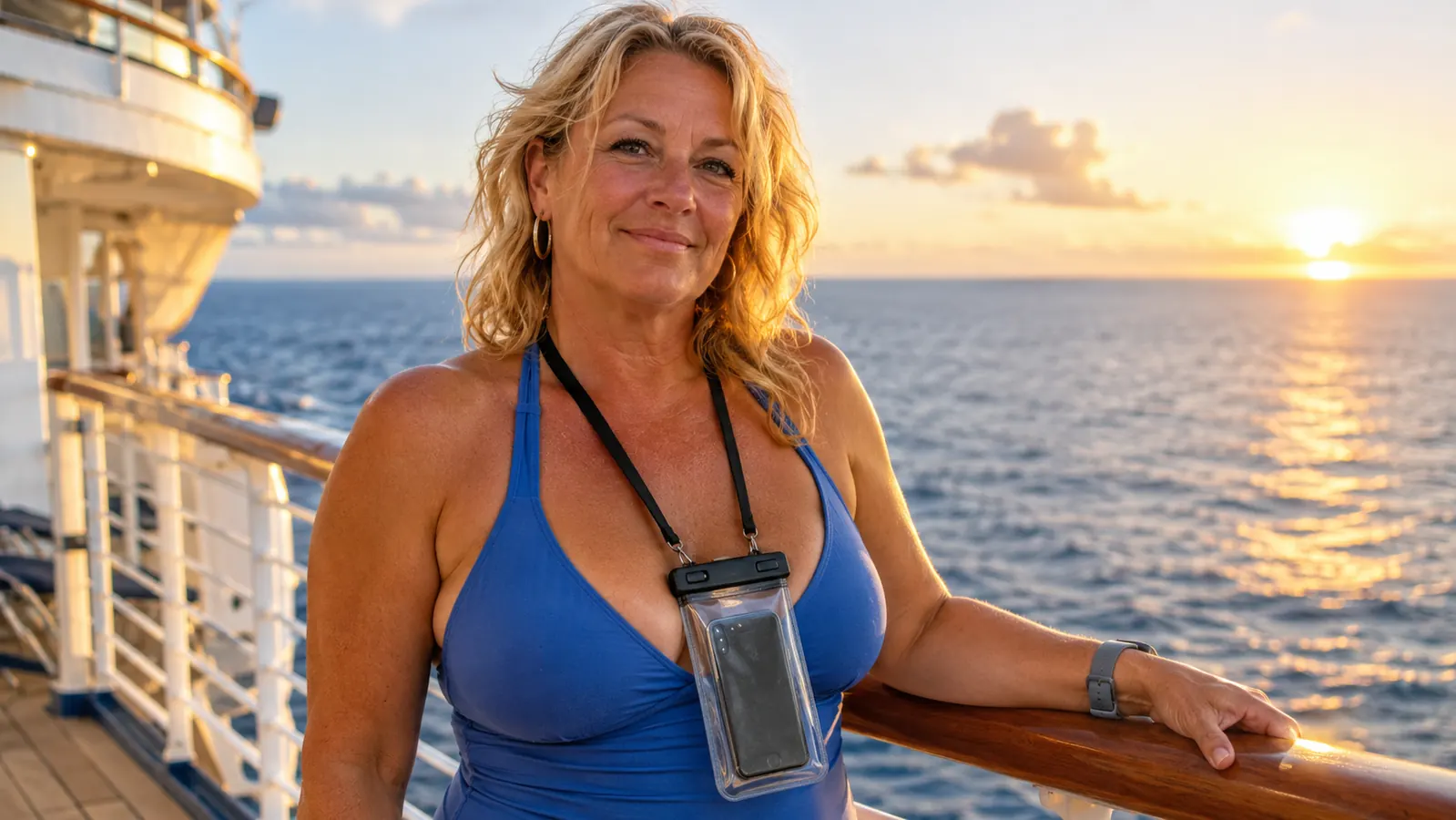
Fourteen cruises in, my packing list has stopped growing and started shrinking. These days it is about a dozen things I would genuinely notice the absence of, and the smallest of them is a phone pouch I bought before our eleventh sailing. JOTO makes it, it holds a phone up to seven inches, and it is the one item Gus and I both reach for before we leave the cabin.
Here is what I did not expect. On a ship, your phone is not mostly a phone. It is your camera, your map in port, your way to find each other on a big deck, and your backup for the app that has your boarding time on it. Which means it comes with you into exactly the places where water and sand are the whole point. The JOTO pouch is the fix, and four sailings in I can tell you specifically why it stays in the tote.
The thing I pack before the sunscreen
Two JOTO pouches, tested in the bathroom sink, live in the front pocket of my tote from the day I start packing. Four sailings, two phones, no leaks yet.
Amazon Check Today's Price on Amazon →Tender boats and wet landings do not get a vote
You do not always dock at a pier. Some ports put you on a tender, a small boat that ferries you in, and boarding one usually means crossing a moving gap with one hand on a rail while a crew member takes your bag. I have watched two phones go into the water that way. In the pouch, on its neck strap, mine sits against my chest with the seal closed, and both my hands are free for the rail. That is the whole argument, and it holds at every port where the ship does not tie up.
Pool deck afternoons stop being a phone-sitting job
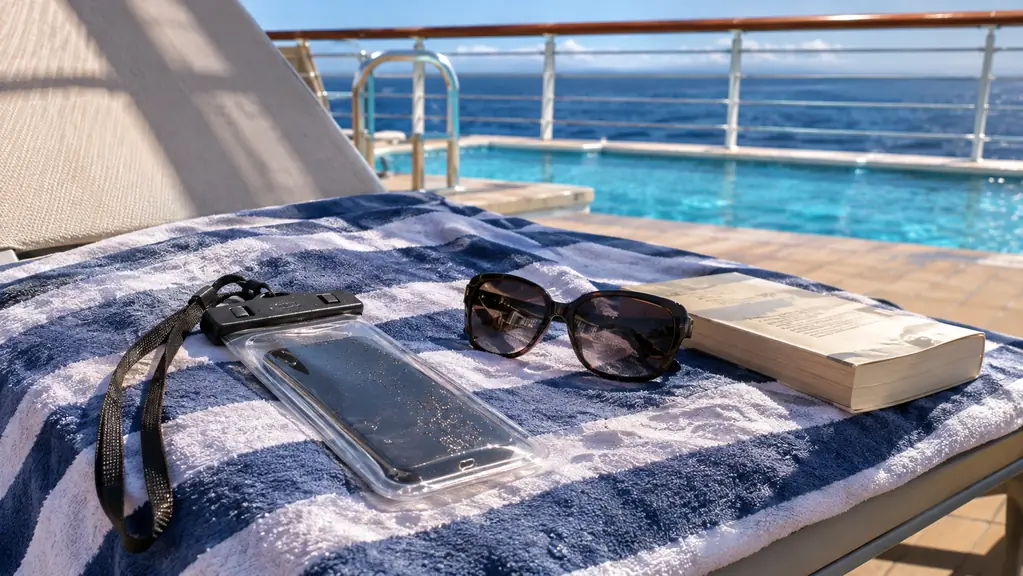
The pool deck is where phones die quietly. Not from swimming, from the puddle on the table, the splash from a cannonball, the drink sweating onto the surface next to it. Ours hangs off the back of a lounger or lies flat on a damp towel with the phone sealed inside. I read, Gus dozes, and neither of us spends the afternoon guarding a phone like it is a tray of full glasses. That alone changed how the sea days feel.
Cozumel snorkeling, at actual snorkel depth
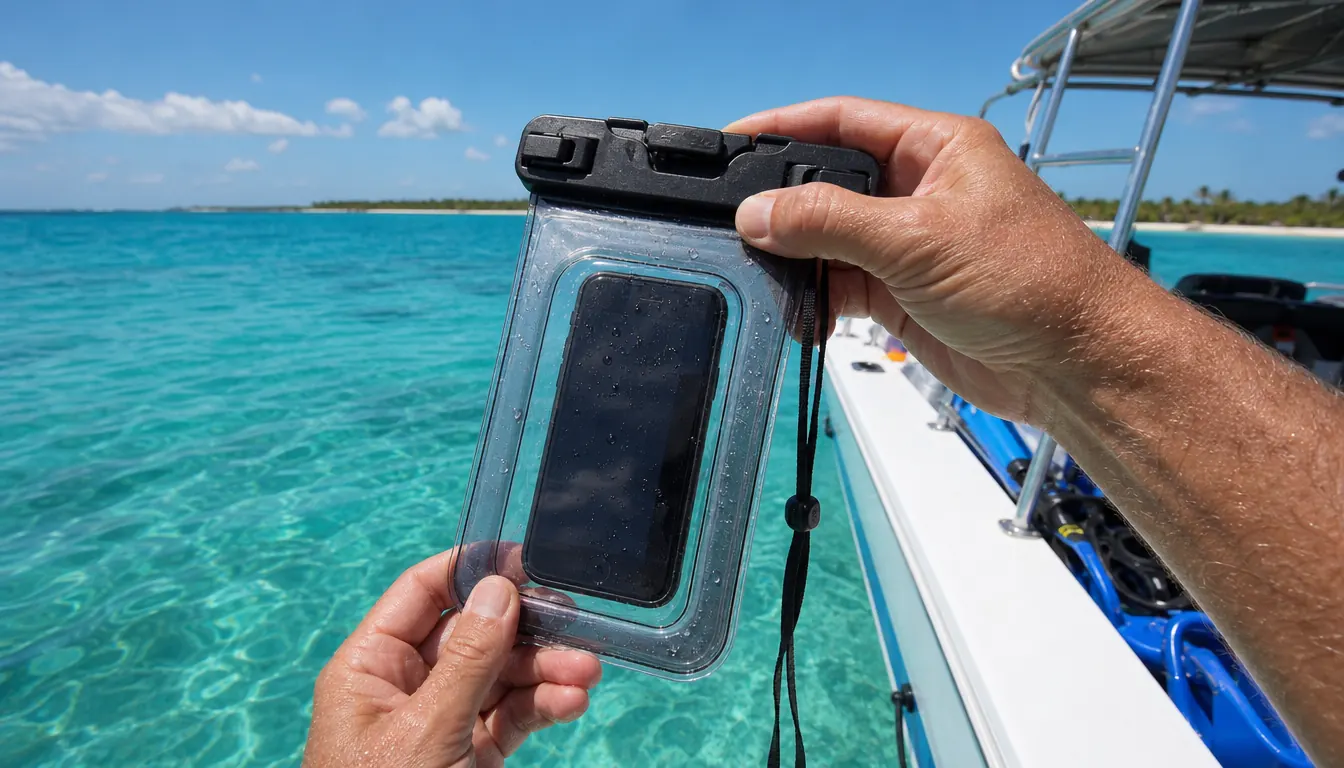
Our Cozumel day put us on a catamaran with snorkel gear, and I wore the JOTO pouch around my neck under my swim shirt. It went into the water with me at snorkel depth for close to forty minutes. The listing rates it to 100 feet IPX8, which is deeper than I will ever go on purpose. I opened it on the boat afterward with the mild dread of a person checking a lottery ticket. Bone dry. We have done that twice now.
Sand stays on the outside where it belongs
Sand gets into everything. It works into the charging port, behind the case, into the speaker slots, and then your phone sounds like it is underwater when it is nowhere near water. Sealed in the pouch, the sand stays outside. I shake it out at the end of a beach day, wipe the window with the dry wipe that comes in the box, and the phone never actually touches the beach. Back at the pier I rinse the outside under a tap and let it air dry on the desk.
Drizzle in port is not a phone emergency
Not every sailing is a Caribbean sailing. Our Alaska trip out of Seattle gave us three days of sideways drizzle, and our Barcelona port day in 2023 had rain that could not make up its mind. A pouch does not care about weather. I have walked through a downpour with the phone around my neck and pulled it out dry to check a map. Kitchen zip-top bags work until the seal softens in sun and salt, and they always pick the worst moment to give up.
Both hands free on embarkation day
Embarkation day is the one day you are carrying too much and need too many things at once. Passport, boarding pass, the health questions, my tote, and whatever Gus has set down somewhere behind me. The pouch hangs on its strap and both hands stay free. I keep the paper copies in the tote and the app version around my neck, so if the terminal signal drops, and it does, I still have our boarding time in front of me instead of in a pocket under three other things.
It becomes the small safe in your day bag
On port days the pouch holds more than a phone. Ship key card, a little cash, my ID, all sealed in together. Water and sand stay out of the lot, and everything lives in one known place, so I am not patting four pockets while a taxi waits. Back in the cabin the pouch goes on a wall hook and everything comes out in one motion. It is a small thing that prevents a small argument, which on a port day is worth more than it sounds.
You can read it and tap it without breaking the seal
The front window is clear enough to read a message and tap through. That matters more than it sounds. The temptation with any waterproof bag is to open it to check something and then reseal it badly while standing in wind on a wet dock. If I can see the notification and dismiss it without opening the pouch, the seal keeps its integrity. The JOTO pouch fits phones up to seven inches diagonal, with a clear window of about 3.2 by 6.37 inches, so both of ours go in with room to spare.
The closure gives you something to feel with your thumb
The closure is a simple snap and lock. You fold the top over, click it shut, and then run a thumb along the seam to feel that it is seated all the way across. I like that feedback. A plastic zip top tells you nothing, and a zipper on a wet bag is the part that fails first. I do the thumb check out of habit now, the same way I check a seatbelt, and it costs me two seconds at the cabin door.
Fifty grams, so there is no reason to leave it home
Fifty grams. Less than a set of keys. It folds flat into the front pocket of my tote when we are not using it, and there is no trip where I have thought about leaving it behind. We book an interior or oceanview cabin to keep the fare down, which means every item has to justify the space it takes. This one takes almost none and solves a whole category of problem. We own two JOTO pouches, one each, because Gus would lose his own head if it were not attached.
Before every trip I fold a paper towel into each pouch, snap it shut, and hold it under the bathroom tap for a slow count of thirty. Four sailings in, both towels have come out dry.
What I'd Skip
Two things I would not bother with. The first is a zip-top bag from the kitchen drawer. It passes the sink test on day one and then the seal softens in sun and salt, and you find out at the worst possible moment. The second is a pouch that has never been tested before you leave home. Before every trip I fold a paper towel into each JOTO pouch, snap it shut, and hold it under the bathroom tap for a slow count of thirty. Four sailings in, both towels have come out dry. That minute is the whole reason I trust the thing.
I also take the everyday phone case off before the phone goes in. The listing notes that some larger phones need the case removed to fit inside the 3.35 by 6.69 inch pouch, and mine is one of them. The JOTO box comes with a wet wipe and a dry wipe as well, which I keep in the tote for the salt film that builds up on the window after a beach day. If you have a thick case and a big phone, try the fit at home on the kitchen counter rather than on the dock with a tender waiting.
Pack it before you pack anything else
Small, flat, and tested in the sink before every sailing. If your phone comes to the pool deck and the beach with you, this is the simplest way to stop worrying about it.
Amazon Check Today's Price on Amazon →