
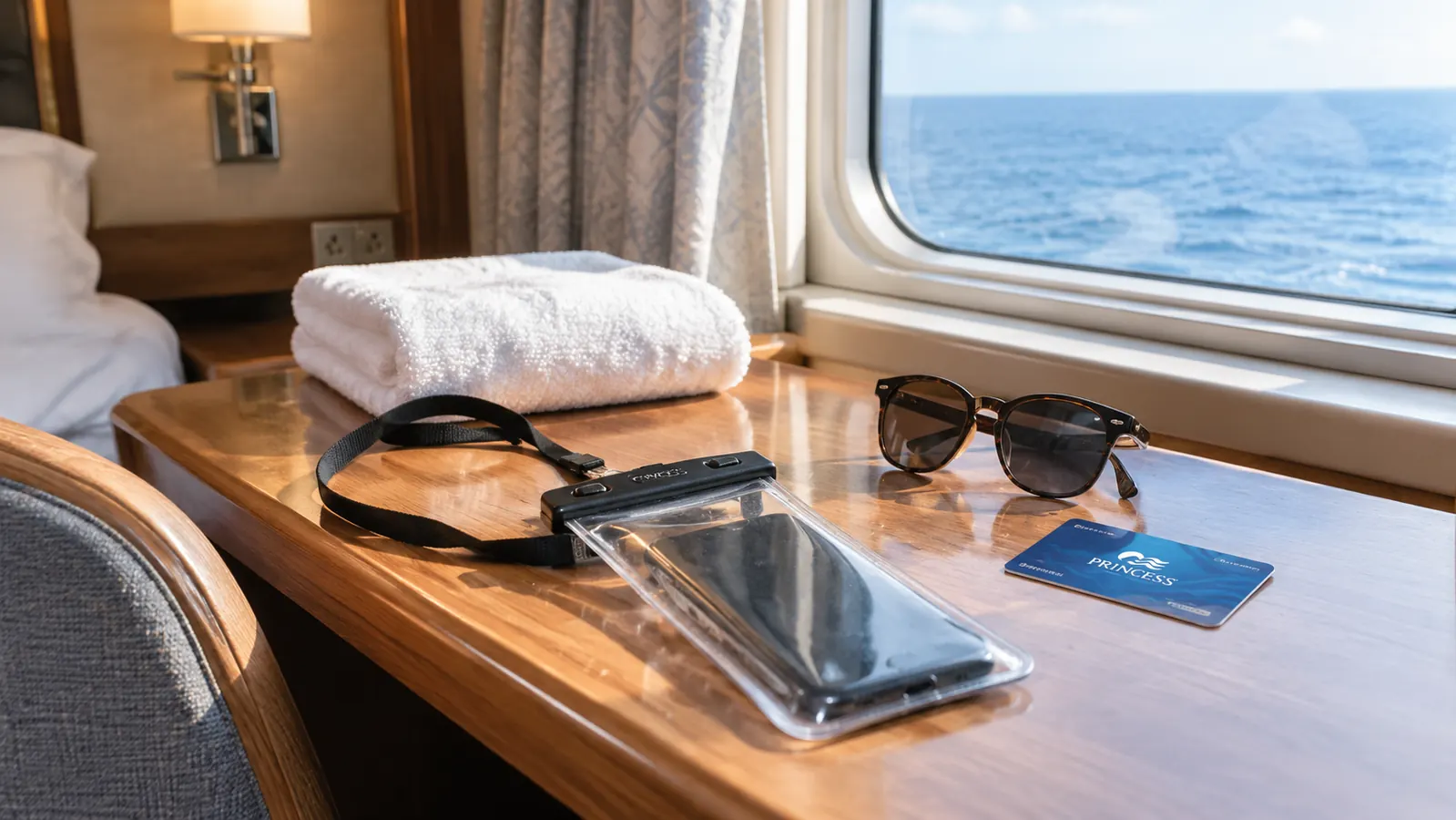
Gus and I have packed for 14 cruises out of Port Canaveral, Seattle, and Barcelona, and the phone question never goes away. On a snorkel boat in Cozumel, a pool deck with a spray bar, or a rainy morning in Alaska, you want your phone close and dry. Before our 11th cruise I bought two JOTO waterproof phone pouches, one for each of us. We have used them on four sailings since, and they have kept both phones dry through snorkeling, pool splash, and one very wet tender ride. This is not a knock against rigid waterproof cases. It is a question of which tool earns the space in a tight oceanview cabin.
The short answer: for most cruise passengers, the JOTO pouch is the better travel piece. It packs flat, fits phones up to 7 inches diagonal, and lives on a neck strap when your hands are full. A rigid waterproof case is the better everyday case. It stays on the phone, takes a drop better, and is easier to shoot with underwater. If you want one item that handles the wet parts of a cruise and then goes back in the tote, buy the pouch. If you want your phone armored from the moment you leave the cabin, buy the rigid case.
| JOTO Pouch | Rigid Waterproof Case | |
|---|---|---|
| Everyday handling | Phone goes in the pouch for wet activities, then comes out for dinner | Case stays on the phone all day |
| Drop protection | A barrier against water, not armor against a hard fall | Hard shell takes the knock instead of the phone |
| Underwater camera | You shoot through the clear window; touch can be fussy when wet | Rigid body and lens opening keep the camera steady |
| Phone fit | Fits phones up to 7 inches; window is 3.2 by 6.37 inches | Built for one model, so fit is exact but not shareable |
| Packing bulk | 50 g pouch packs flat in a tote | Adds daily bulk to the phone |
| Charging routine | Phone comes out and charges normally | Charging usually means opening a sealed port or removing the case |
| Wet-hand setup | Snap and lock closure, neck strap, no small parts to lose | Port covers take two hands before you get in the water |
| Sharing between two phones | One pouch design covers both phones | One case per phone model |
| Best for | Snorkeling, pool deck, rain, and sharing with a partner | Daily wear and rough shore excursions |
Where the JOTO Pouch Wins
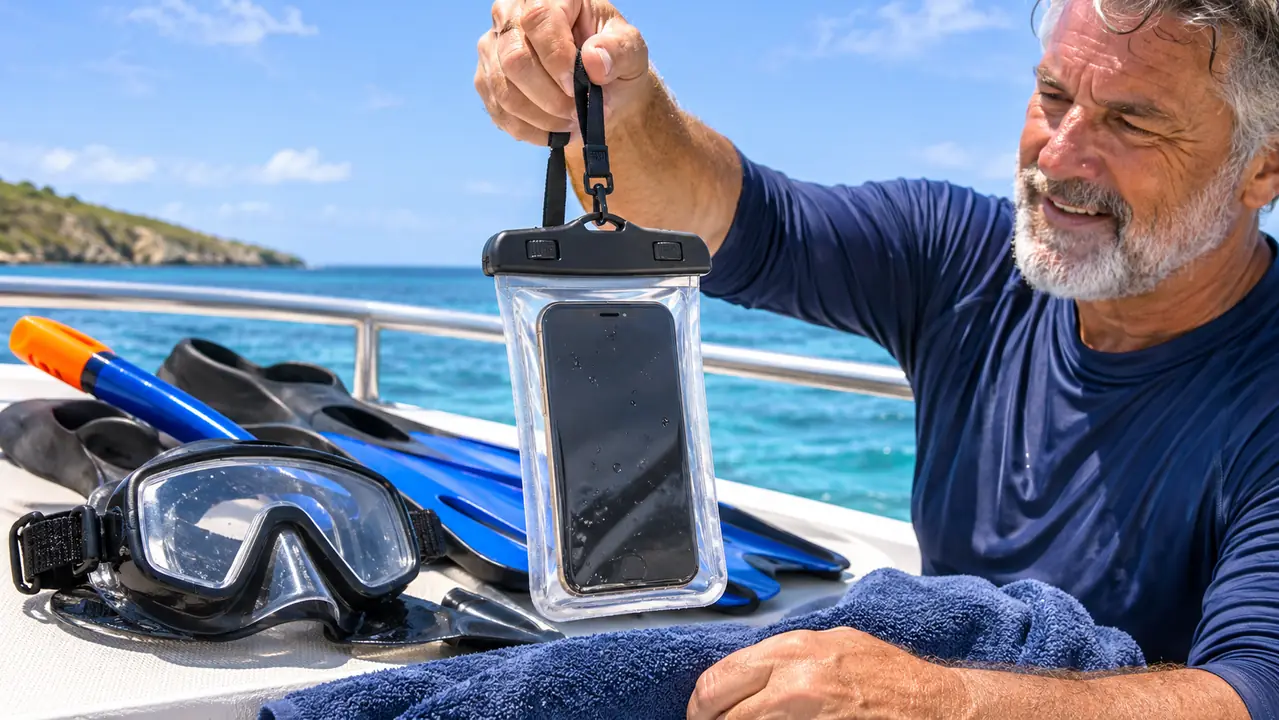
The first win is fit and sharing. JOTO lists the pouch for phones up to 7 inches diagonal, with a clear window of 3.2 by 6.37 inches and room for devices up to 3.35 by 6.69 inches. That is a mouthful of numbers, but the practical result is simple: my phone and Gus's phone both go in the same pouch design, and I do not have to buy a new case when one of us upgrades. The neck strap matters more than I expected. On the snorkel boat, I wore the pouch under my rash guard strap and kept both hands free for the ladder. Gus wore his around his neck at the pool and never set it down on a lounger, which is how phones get left behind.
The second win is packing. The pouch weighs 50 g and folds flat in my carry-on tote. It does not add bulk to my phone at dinner or on a shore day when I am not near water. The snap and lock closure is easy to open on the boat and easy to check before I get in. Ours came with a wet wipe, a dry wipe, and a screen protector, which I keep in a zip bag with the pouch. After four sailings, the closure still snaps with a firm click, and I have not had a drop of water inside. That is the whole job. I do not ask it to be a phone case for daily life.
Where the Rigid Case Wins
The rigid case wins on drops. A pouch is a barrier against water, not armor against a rock. If you are climbing over wet rocks on an Alaska shore excursion or walking a slick pier in the Mediterranean, a hard shell spreads the impact and keeps the phone rigid in your hand. I have seen a phone in a pouch slip off a pool chair and land screen first. The phone survived, but the pouch did nothing to soften the hit. A rigid case would have done more.
It also wins on underwater photos. A rigid waterproof case keeps the phone stiff, lines up the lens, and lets you hold it with one hand while you fin. The JOTO pouch works for a quick video of a fish, but the touchscreen can be fussy when the window is wet, and you are pressing through plastic. I got a few good clips in Cozumel. I also got a lot of blue nothing while I tried to find the shutter button with wet fingers. If underwater photography is the main reason you are buying waterproof gear, the rigid case is the easier tool.
If your phone needs to survive the snorkel boat, not a rock climb, the JOTO pouch is the one I pack
Two pouches have covered four sailings, two phones, and one very wet tender ride. They pack flat, fit up to 7 inches, and keep the phone dry without turning it into a brick for the whole trip.
Amazon Check the JOTO Pouch on Amazon →How I Test a Phone Pouch Before a Cruise
Before every trip, I do the same sink test. I put a folded paper towel inside the pouch, snap the closure, and set it in a bowl of water for 20 minutes. Then I dry the outside, open it, and check the paper. If the paper is dry, the pouch goes in the suitcase. If it is damp, the pouch stays home. I have done this before all four sailings with the JOTO pouches, and the paper has been dry every time. It takes less time than finding a phone repair shop in a foreign port.
I also check the seal for grit. Sand is the enemy of any snap closure. After a beach day in Cozumel, I rinse the pouch in fresh water, dry it with the cloth, and open and close the snap a few times to make sure nothing is caught in the channel. The JOTO pouch has a simple snap and lock access, which is one reason I trust it. There is no zipper to jam and no tiny slider to lose. I can see the whole seal with my eyes.
At the pool deck, I keep the pouch on the neck strap and put the phone in only when I am near the water. That is the honest trade. The pouch is not a case I leave on all day. It is a dry bag for the phone, and I use it like one. If you want to text from a lounger with wet hands, the pouch will let you, but you will be pressing through the window and hoping the touchscreen cooperates.
The Small Specs That Decide It
The JOTO pouch is IPX8 certified and rated to 100 feet. That number is far beyond anything I ask of it on a cruise. I am not diving to 100 feet. I am standing in waist-deep water at a beach club, or holding the pouch above a wave that broke higher than I expected. The rating tells me the seal is built for more than a splash. It does not tell me the pouch is indestructible. Those are different claims, and it is worth keeping them separate.
The clear window is 3.2 by 6.37 inches. That is big enough for a modern phone, but not so big that the pouch feels like a tablet sleeve. The whole pouch weighs 50 g, about the same as a small bar of hotel soap. I know that because I weighed it on the kitchen scale next to a bar of soap, which is the kind of thing a retired librarian does on a Tuesday. It disappears in the tote.
The neck strap is not a lanyard afterthought. It is the reason the pouch works on a moving boat. I can hang it inside my shirt when I climb a ladder, or loop it around my wrist when I lean over the rail. The pouch also comes with a wet wipe, a dry wipe, and a screen protector. I use the wipes on the window and keep the screen protector in my cabin kit. None of that turns the pouch into a rigid case. It just makes the wet part of the day easier.

What the Pouch Is Not
The JOTO pouch is not a case I would use at home. It does not protect the phone from a drop on the kitchen floor, and it does not make the phone easier to hold. It is a dry bag with a clear window and a neck strap. When I see a pouch described as a phone case, I understand the shorthand, but I do not expect case-level protection. That is the trade I make for something that folds flat and fits both phones.
It is also not a camera housing. The clear window is good for a quick photo at the pool, and it kept my phone dry while I filmed a fish in Cozumel. But a rigid case with a lens opening and a stiff body is easier to aim underwater. If I were planning a dive trip rather than a cruise, I would borrow a proper housing or buy a rigid case. For a four-night Caribbean sailing with one snorkel stop, the pouch is enough.
Packing Notes for a Small Cabin
In an interior or oceanview cabin, every item has to justify its space. The JOTO pouch does. It goes in the outside pocket of my carry-on tote with the wet wipe and dry wipe inside, and it takes up less room than a paperback. I do not need a dedicated drawer for it. On the last night, I rinse it, dry it, and put it back in the zip bag. It is one of the few pieces of gear that does not add to the pile on the desk.
The rigid case takes a different kind of space. It stays on the phone, so it is always with you, but it also makes the phone thicker in a pocket and heavier in a small bag. If you are packing for two people in a tight cabin, that bulk is not nothing. The pouch is the easier item to pack and the easier item to share. The rigid case is the easier item to live with once you are ashore.
The JOTO pouch is not armor. It is a dry bag for a phone, and on four sailings it has done that one job without a leak.
Who Should Buy Which
Buy the JOTO pouch if your wet phone moments are snorkeling, pool decks, beach days, rain, and boat rides, and you want one item that fits both phones and packs flat. Buy it if you are not looking for a full-time case and you like the idea of a neck strap. It is also the better choice if you travel with a partner and do not want to buy two model-specific cases. Our two pouches have covered four sailings, and I still check the seal before every trip, but I have no reason to replace them.
Buy a rigid waterproof case if you want the phone protected all day, if you drop your phone more than you would like to admit, or if underwater photos are a big part of your trip. It is the better tool for rough shore excursions and daily wear. It is not the better tool for sharing between two different phones or for packing in a tote. It adds bulk and it commits you to one phone model, but it is the better tool for daily protection. That is the trade.
Gus and I split the difference. On the ship, he carries the JOTO pouch for the pool and the snorkel boat. At home, a rigid case makes more sense for the way he uses a phone. I do not need one for daily life, so the pouch is enough for me. If you are packing for a cruise and you only want one waterproof item, start with the pouch. If you want one case that never comes off, start with the rigid case.
One pouch, two phones, four sailings, zero water inside
The JOTO pouch is the item I replace last and check first. It fits phones up to 7 inches, seals with a snap and lock closure, and hangs on a neck strap when your hands are busy with a ladder or a plate.
Amazon Check the JOTO Pouch on Amazon →