
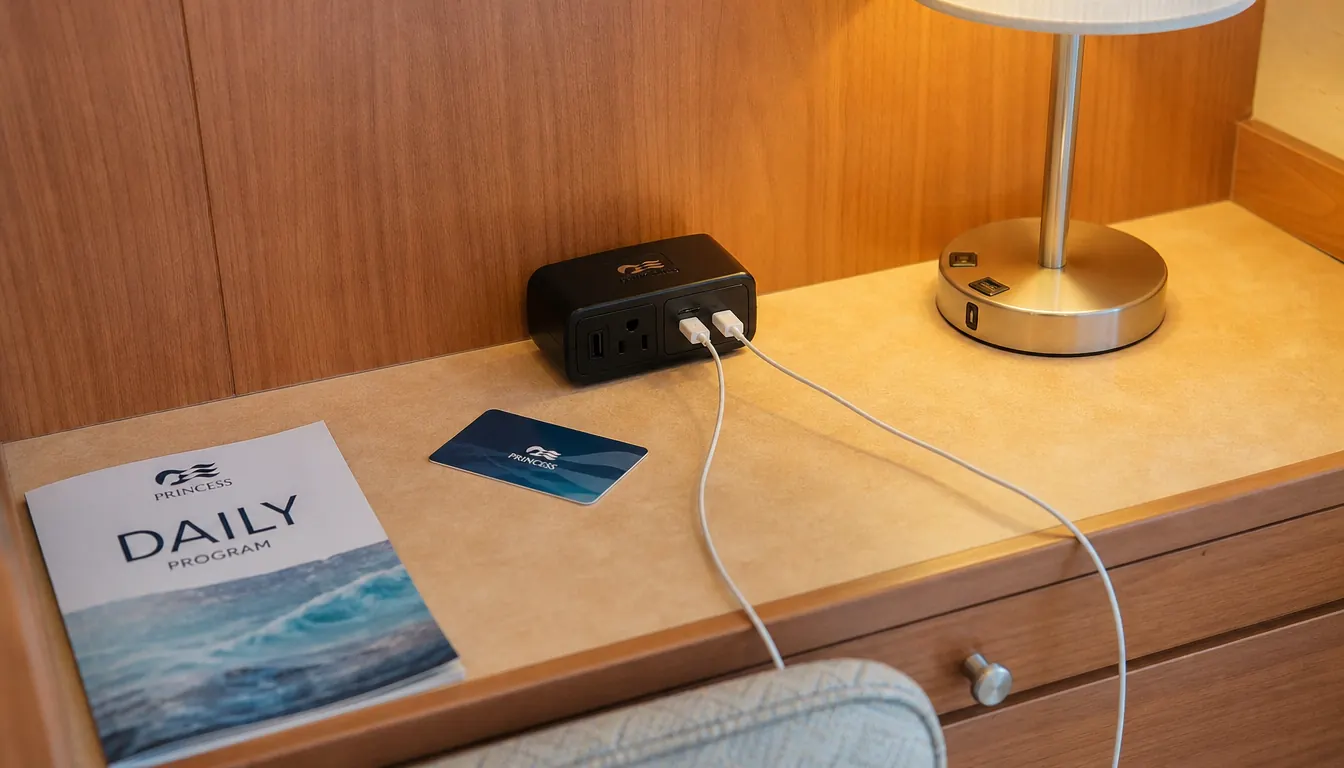
Nobody warns you that the hardest part of an inside cabin is not the dark. It is the single outlet at the desk. On our tenth cruise I finally bought the Cruise On non-surge power strip, and I have used it on five sailings since, from Port Canaveral to Barcelona. This is not a love letter to a gadget. It is what I would tell a friend in the terminal waiting area, including the parts that irritate me.
The short version: it does the one job it claims. It has been through embarkation security five times without a second look, it has never tripped anything in the cabin, and it turns one desk outlet into five. It will not fix a cabin that was badly designed. It just means Gus and I are not negotiating over a charger at eleven at night.
The Quick Verdict
Five outlets in a five-ounce block, no surge circuitry to get it pulled at security, and no cord to untangle. It earns its space in the bag. It will not reach across a cabin, and it will not change the voltage.
Amazon Check Today's Price →The first thing I unpack, before the lifeboat drill
Non-surge by design, so it is built around ship rules rather than living room rules. Two USB ports and three AC outlets, five ounces, about three and a half inches square. Five sailings in my tote and it has never been questioned at the pier.
Amazon Check Today's Price on Amazon →Before this I tried the obvious things. A plug adapter that turned one socket into three, which worked until the block was heavy enough to sag out of the wall. A drugstore strip, which is exactly the sort of thing security is looking for now. And for two trips, a strict rotation system where my e-reader charged in the morning and Gus's razor charged after dinner. That lasted until the night he forgot, and stood in the bathroom at seven in the morning with a dead razor and a formal night ahead of us.
So when I say I came to this thing late and reluctantly, I mean it. I am sixty-one, I spent thirty years as a middle-school librarian, and I do not buy gadgets because they look clever in a photograph. I buy them because the alternative is worse. The alternative here was another cruise of trading chargers back and forth and hoping the desk outlet was not hiding behind a lamp.
The Outlet Problem Nobody Puts in the Brochure
Cabin outlets are an afterthought in the design. In an inside or oceanview cabin, you typically get one or two at the desk and nothing within reach of the bed. The bathroom has a shaver outlet that will not take a normal plug. So two adults with two phones, an e-reader, a razor and a camera battery are sharing one socket, and that socket is usually low, behind the desk, and awkward to get at with your hand, let alone a plug.
Which is why people bring a surge protector from home. That is the one that gets taken. Ship wiring is not house wiring, and the lines treat surge-protective strips as a risk worth stopping at the pier. I have watched a man two places ahead of me in the security line hand over a strip still in its packaging and walk away without it.
The Cruise On strip is built the other way around. There is no surge protection in it at all, which sounds like a downgrade until you understand that the surge circuitry is the part the lines object to. The listing names Carnival, Celebrity, Princess, Norwegian, Holland America, MSC and Virgin Voyages as lines it is compliant with. I am not going to tell you that guarantees anything on your sailing, because rules get tightened and I cannot see your itinerary. What I can tell you is my own record: five embarkations, five trips through the x-ray tray, no questions, no confiscation.
That is the whole reason I bought the Cruise On strip. Not because five outlets is a marvel. Because it is the version I am allowed to keep.
How It Has Performed on Five Sailings
It lives on the desk. The footprint is about three and a half inches by three inches and it weighs five ounces, so it sits flat and stays put when a cable is tugged. The listing calls the shape a squircle, which is a silly word for a square with softened corners, and in practice it means there is no sharp corner digging into the desk laminate. Three AC outlets on one face, two USB ports on the other, five devices at once.
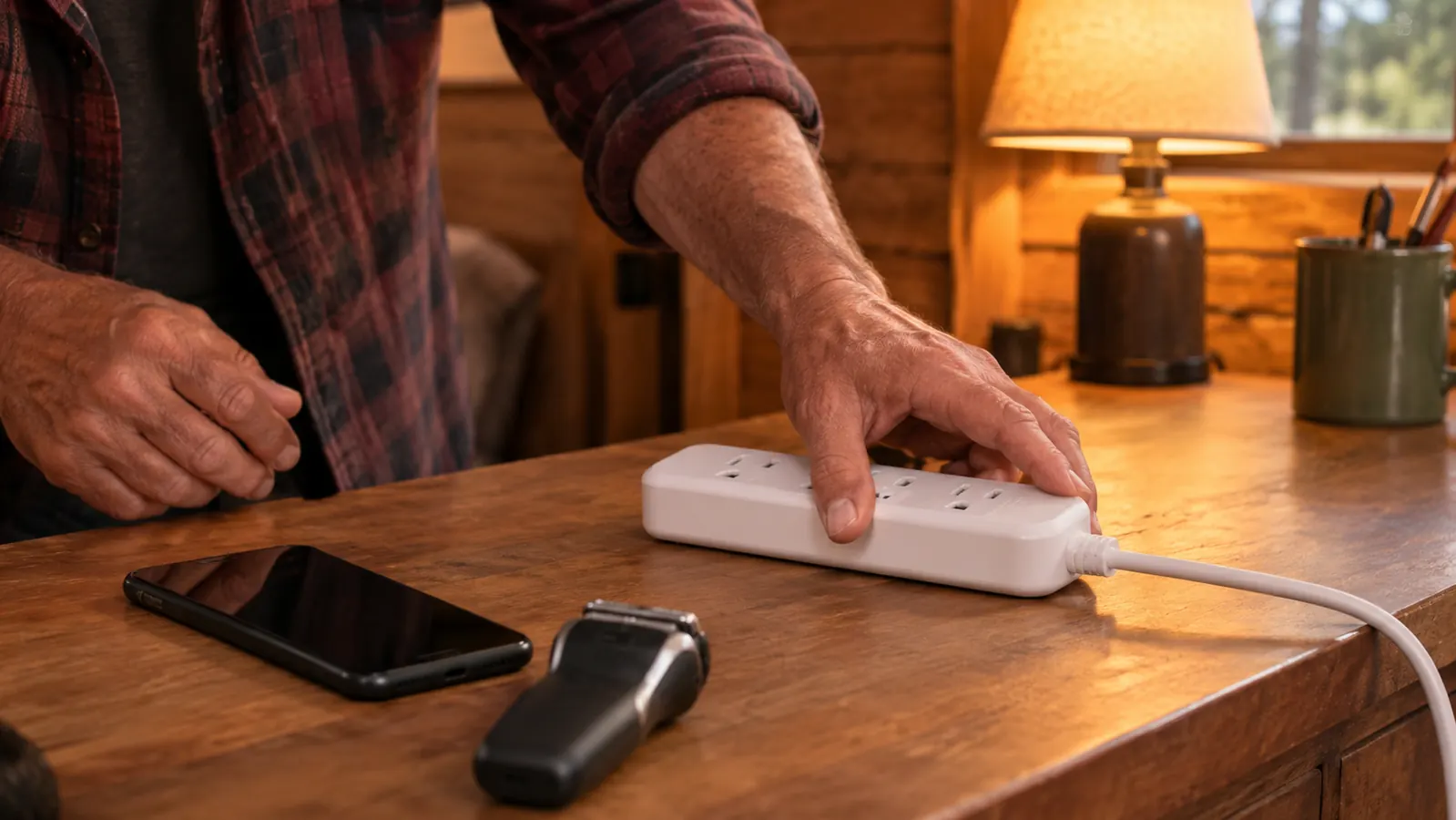
A normal night in our cabin looks like this: both phones on the USB ports, my e-reader on an AC outlet, Gus's electric razor on a second AC outlet, and the third AC outlet free for the camera battery. It does that without getting warm to the touch, which is the only thing I really check on a power strip in a small room.
Gus's razor is the greedy one. It wants a full charge the night before a formal night, and it takes a couple of hours to get there, so it goes on the outer AC outlet straight after dinner and stays there until we turn in. The block itself never got more than faintly warm, and I have made a habit of checking it with the back of my hand before I switch off the lamp. Two seconds, and then I stop thinking about it until the morning.
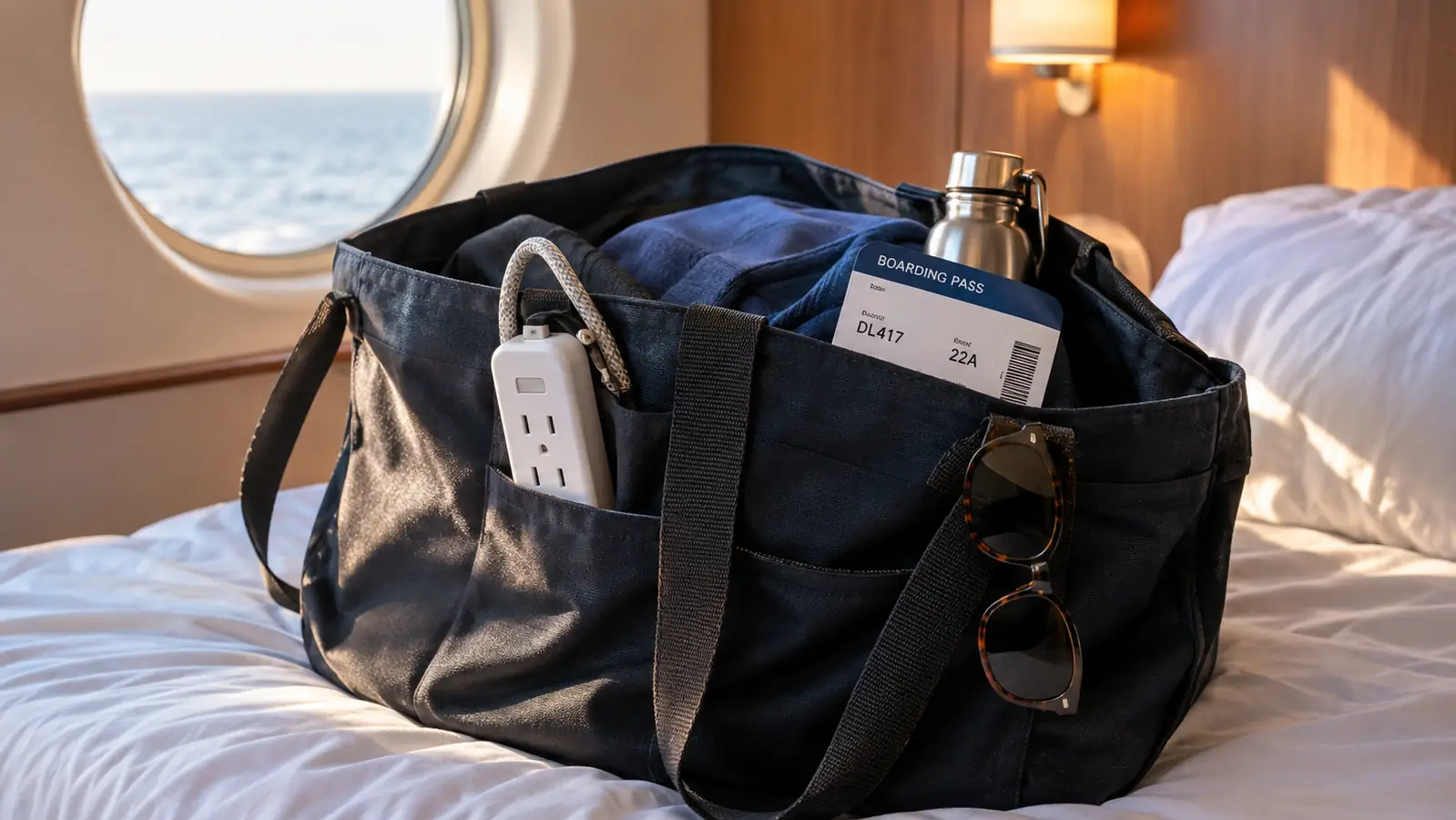
There is no cord. That is the design and it is also the main compromise, which I will get to. What it buys you is nothing to coil, nothing to tuck behind the desk, and nothing to trip over on the way to the bathroom at two in the morning. It goes into the side pocket of my carry-on tote next to the boarding pass and I forget about it until I am unpacking.
One thing I did not expect: it stays put when the ship does not. We had two rough days coming back on the last sailing, the kind where the water glass on the desk needed a coaster and the coat hangers argued with each other all night. The block did not move. Five ounces of polycarbonate with a flat base, and it just sat there doing its job while everything else slid.
Five embarkations, five trips through the x-ray tray, and not one agent has picked it up for a second look.
What It Does Not Do
Three honest limits, and I would rather you heard them from me than found them out in the cabin. First, it does not reach. With no extension cord, the block has to sit at the outlet or hang from it. That has been fine in every cabin we have had, because the desk outlet is right there at desk height. If your cabin has a socket down behind the bed frame or around a corner, this will not help you. You want a corded strip, and you want to check your line's current rules before you pack it.
On the Barcelona sailing our cabin had the desk socket set back under a lip of shelving, and the block had to sit sideways to fit, with the razor plug pointing out over the edge of the shelf. It worked. It was not elegant. If that socket had been around the corner by the bed instead, the block would have stayed in the tote all week and I would have gone back to walking my phone over to the desk every evening, which is exactly the routine I bought it to end.
Second, it does not change voltage. It is rated at 125 volts with a North American three-pin plug. On the Barcelona sailing our cabin had both a US-style socket and a European one, and I used the US one. If your cabin gives you only European sockets, you need a plug adapter as well, and this block on its own will sit in the bag doing nothing.
Third, and this is the one I care about, it does not give the cabin more power. It splits what is already there. The listing shows a 15 amp rating on a 125 volt circuit, which is plenty for phones, a tablet, a laptop, a camera and a razor. It is not for anything that heats. I do not plug a curling iron or a travel iron into it. Not because the block cannot take it, but because the lines ban those appliances outright, and I am not spending an afternoon explaining myself to an officer in a corridor.
What I Liked
- No surge circuitry, which is the part the cruise lines object to
- Three AC outlets and two USB ports, five devices at once
- Five ounces, roughly three and a half inches square
- No cord to coil, tuck or trip over
- Sits flat on a desk and stays put when a cable is pulled
- Five embarkations with no questions at security
Where It Falls Short
- No cord, so it cannot reach a socket behind the bed or around a corner
- Does not convert voltage, it is 125 volts with a North American plug
- Fat plugs crowd each other on a block this small
- No surge protection, so it is not the one to leave plugged in at home
- No help if your cabin only has European sockets
The Parts That Annoy Me
Small grievances, but they are real. The outlets sit close together. On a block three inches wide, two adapters with fat bodies will nudge each other and one ends up in the outer socket at an angle. It has never stopped me charging anything, but it is the reason the third AC outlet goes to something slim, like a camera charger, rather than the razor brick.
The worst combination I have found is Gus's razor brick next to the camera charger. Both have bodies wider than the plug face, so the second one has to go in the far socket or it pushes the first one loose. The first night I owned it, I had the razor in the middle socket and the camera charger would not seat at all, no matter which way I turned it. I moved the razor to the end socket and it has been fine ever since. Ten minutes of fiddling to learn a rule I now follow without thinking.
And a heavy plug can make the whole block tip forward if you set it right at the front edge of the desk. I moved ours back against the wall on the first night and it has not moved since. A two-second fix, but nobody tells you to do it, so now I have.
What Else I Looked At
Before I bought, I looked at three other things. A corded travel strip, which gives you reach but is exactly the shape security is trained to look at, and I did not want the argument at the pier. A plug adapter cube that turns one socket into three, which was light and small and worked fine until it did not, because it has no USB ports and we have four things that want USB. And a USB-only charging block, which is neat and fits in a shirt pocket but is useless for Gus's razor, and the razor was half the reason I was shopping in the first place.
The corded one I nearly bought came in a little zip pouch and looked sensible in the photographs. Then I read the reviews, and three separate people described being pulled aside at the pier while an agent went off to find a supervisor. Maybe they were unlucky. Maybe their strip had surge protection printed on the label in small letters. Either way, I did not want to spend the first afternoon of a seven-night sailing standing in a holding area with my suitcase open on the floor, so I put it back on the shelf.
The Cruise On strip was the only one of the four that covered AC and USB in something the size of a coaster, and the only one whose selling point was what it does not have inside it. That is a strange sentence to write and it is true. I bought a power strip for the absence of a feature.
Nobody gave me this, by the way. I bought mine the same way you would, after reading too many listings at the kitchen table. I am a retired librarian in Melbourne, Florida, and the only reason these notes exist is that a neighbour asked me at a barbecue what to bring on her first cruise and I did not want to explain all of this next to the potato salad.
Who This Is For
Two adults, one desk outlet, more devices than sockets. That is the case for it, and if that is your cabin, it will earn its five ounces back on the first night. It is for the person travelling with a phone each, an e-reader or tablet, an electric razor and a camera. It is for anyone who has had a surge strip taken at the pier and does not want to repeat the experience. It is for inside and oceanview cabins where the desk is the charging station, the dressing table and the place the daily program lands. And it is for the packer in the relationship, the one who lays everything out on the spare bed a week early and counts it twice.
Who Should Skip It
Skip it if your cabin's sockets are nowhere near a flat surface. No cord means no reach, and no reach means it stays in the bag. Skip it if you are sailing an itinerary where you expect only European sockets and you do not own a plug adapter. Skip it if what you actually want is surge protection for a laptop or a desk at home, because this block deliberately does not do that and you should buy a proper strip for the house. The two jobs are different and it is worth keeping them separate in your head. And skip it if you travel with one phone and one cable. You do not need five outlets. You need a longer cable, and honestly I envy the simplicity.
What I Do Before Every Sailing
The night before we pack, I plug something small into each of the three AC outlets and both USB ports, at the kitchen table, with a cup of tea going cold beside me. Two minutes. It has never turned up a fault, but I have had a charging cable fail mid-cruise before, and I would rather find that out at home than at seven in the morning on a formal night. Then it goes in the side pocket of the tote. On board it comes out first, before the shoes, before the hanging clothes, before I work out which drawer is mine. Desk, block, phones, done. Then I can go and find a coffee.
Would I buy it again? Yes, and I have effectively answered that by carrying it on five sailings without once thinking about replacing it. What I would tell you is not to expect it to change your cruise. It is a small, unglamorous piece of plastic that solves one specific problem, and it solves it every night without asking for anything in return. The things that matter on a trip are usually like that. Nobody comes home talking about the power strip. They come home talking about the snorkelling, or the night the ship rocked so hard that Gus put his wristbands on at dinner. The strip just quietly makes sure the phone is charged for the photographs.
One desk outlet, two adults, five devices. This is the fix.
Non-surge, so it is built for ship rules. Two USB ports and three AC outlets, five ounces, small enough for a tote pocket. Check the current rules for your line, then check today's price.
Amazon Check Today's Price on Amazon →