
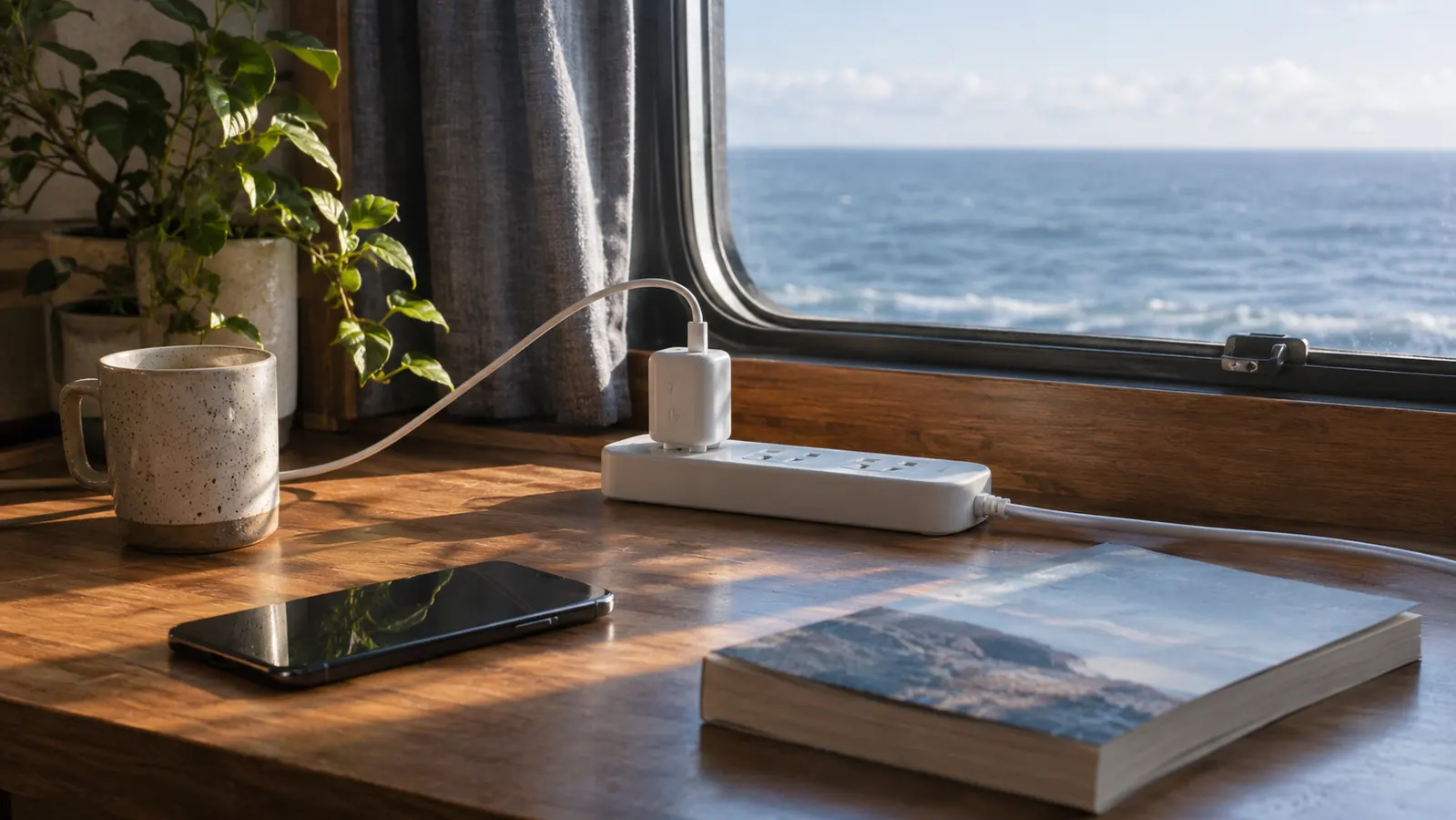
Embarkation day at Port Canaveral has a rhythm I could do in my sleep. Drop the checked bags with the porter, keep the tote on my shoulder, empty my pockets into the gray bin, and hope the officer at the scanner does not decide that my power strip is contraband. On our tenth sailing, the officer picked it up, turned it over twice, read the sticker on the back, and set it down again. That was the day I stopped worrying about it. The strip is the Cruise On non-surge power strip, and the reason it survives security is dull and specific: it is not a surge protector.
Cruise lines ban surge protectors, and they are not quiet about it. A surge protector does more than split an outlet. The part inside that handles a spike is the part the line does not want wired into their system, so the metal brick that lives beside your bed at home gets fished out at the pier and stays behind. A non-surge strip is a plain splitter. This one gives you two USB ports and three AC outlets with no cord and no surge circuit, which is exactly what Cruise On sells. After five sailings with it in my bag, I have opinions about what it does well and the two things that still irritate me.
The Quick Verdict
Five ounces that turn one cabin outlet into three AC and two USB, and walk through embarkation security without an argument. The missing cord is the tradeoff, and it is a fair one.
Amazon Check Today's Price →Five sailings, five trips through the scanner, no arguments
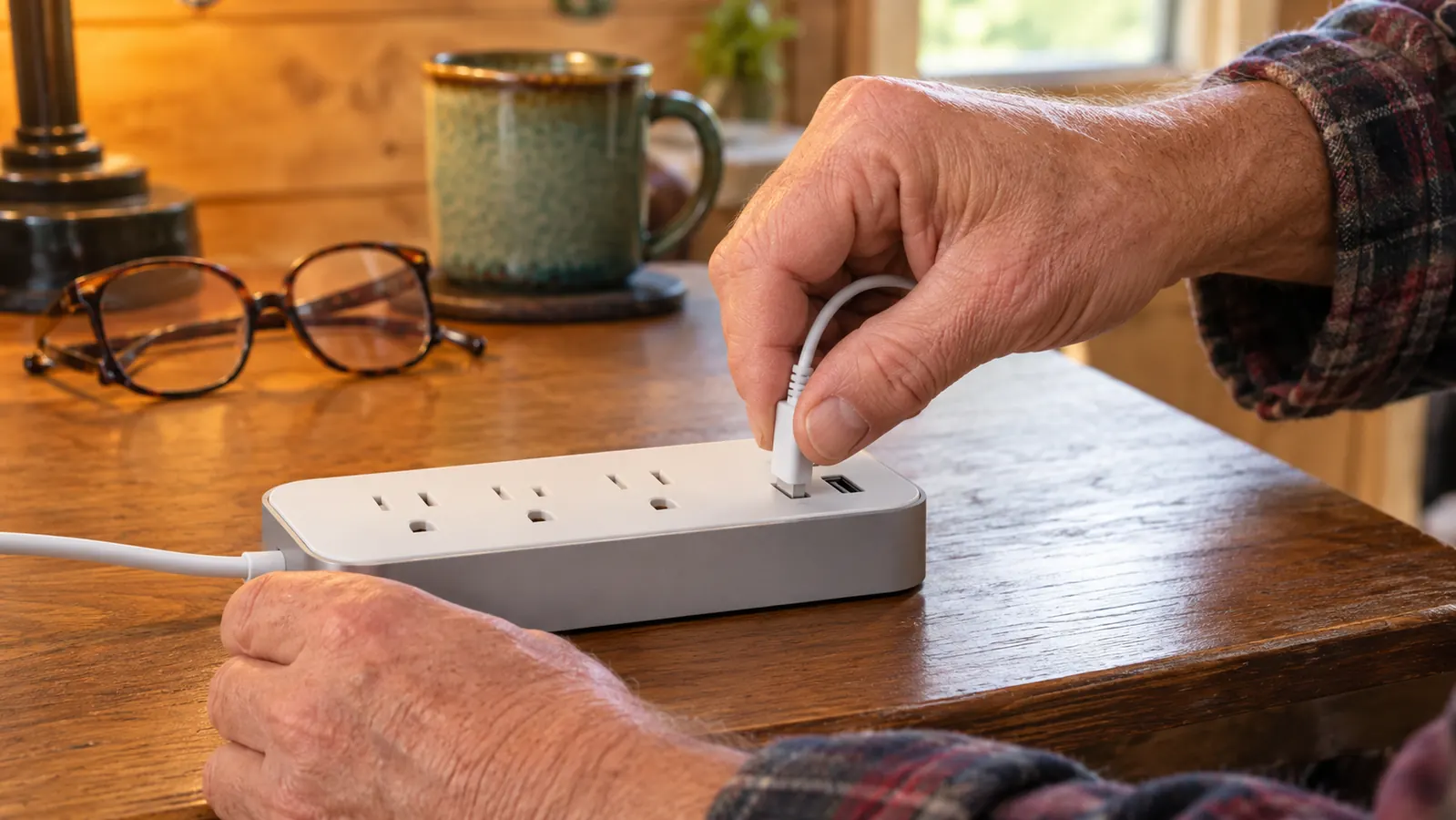
Two USB ports and three AC outlets from a single wall plate. No cord, no surge circuit, five ounces at the bottom of a tote.
Amazon Check Today's Price on Amazon →How I've Used It on Five Sailings
We bought it before our tenth cruise, and it has been in the bag for cruises ten through fourteen. Gus and I book interior or oceanview cabins, which means one small desk, one outlet plate, and a nightstand roughly the size of a cutting board. Space is the thing we plan around. The strip goes on the desk the afternoon we board and stays there until the last morning, when I unplug everything and coil the cables back into the ziplock. It has never moved. It has never needed to.
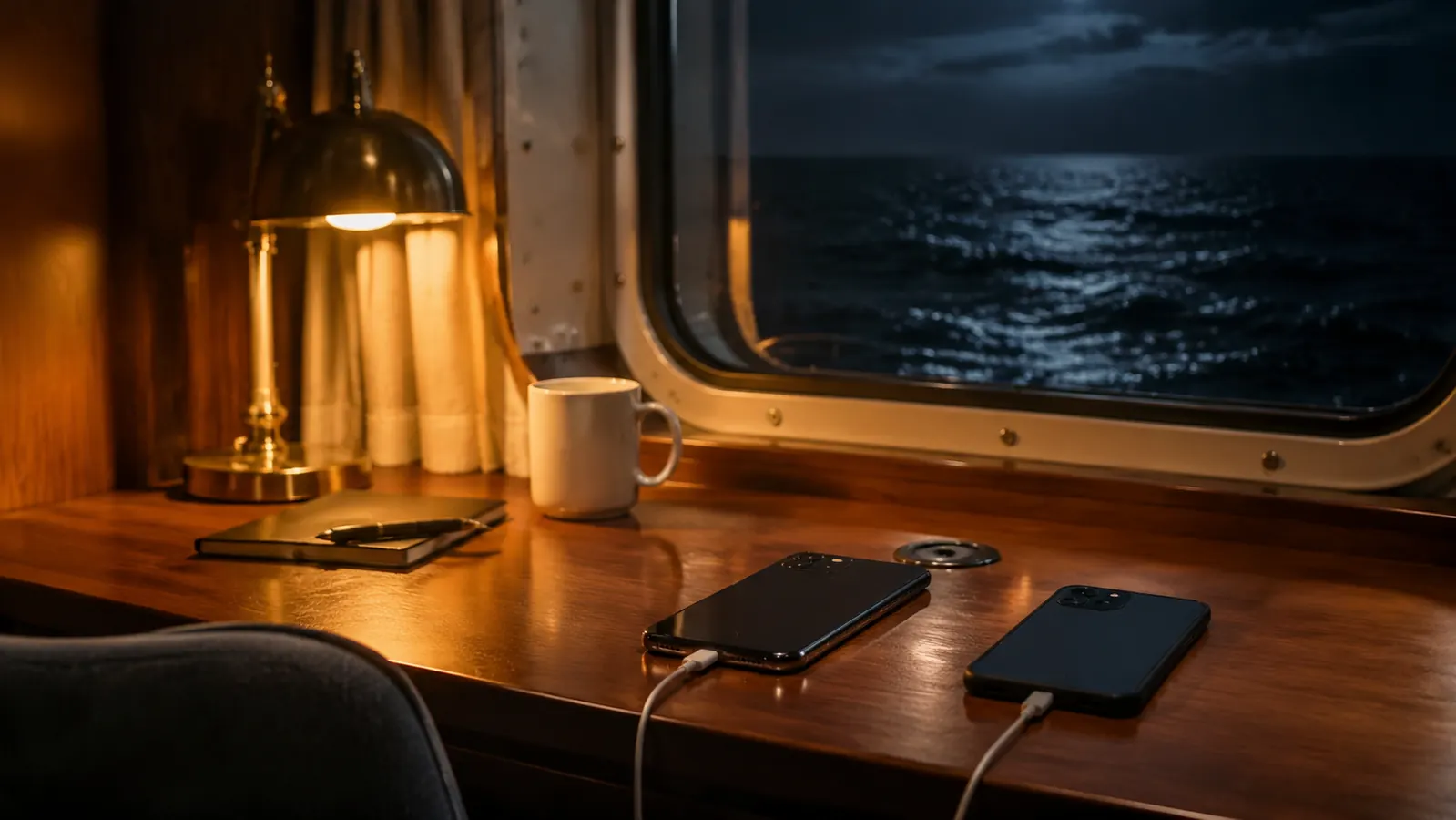
The overnight routine is the same on every sailing. Both phones go on the two USB ports when we turn in. My e-reader takes one AC outlet, because I read until midnight and it does not hold a charge the way it used to. Gus's electric razor takes the second. The third stays open for the camera battery charger on sea days and for nothing at all on port days, which is fine. That is five devices at once if everything is plugged in, and in five sailings I have never had a moment where something had to wait its turn.
The night it earned its keep was the second sea day of our twelfth sailing, when a front pushed the ship around and Gus went to bed early with his wristbands on and the curtain pulled shut. I sat at the desk with the reading lamp on low and had both phones, the e-reader and the razor going at the same time, and nothing blinked or dropped. It is a small thing to be pleased about. I was pleased about it anyway, and I wrote it down in the notebook I keep in the tote.
The security record is the part I care about most. Five embarkations, most of them at Port Canaveral, and it has been picked up and inspected twice. Both times the officer read the label and put it back in the bin. I have watched people ahead of me lose extension cords and a travel iron to the confiscation box, and I have never had to argue about mine. That is not a dramatic endorsement. It is just the thing that matters, because a power strip that gets taken at the pier is a power strip you own and cannot use.
What I Used Before This
For our first nine sailings we brought nothing at all. That sounds like discipline and it was really just ignorance. The cabin had one outlet plate at the desk and we charged one phone at a time, taking turns, which meant my phone sat on the desk from nine until midnight and Gus's went on after that. My e-reader was usually dead by the third day. We told ourselves it was fine because we were on a ship and did not need our phones, and then we spent half an hour every evening managing the charger like it was a shared bathroom.
I thought about a USB block, the little cube with four ports that everyone sells. It would have handled the phones and nothing else, because Gus's razor has a plug and always will. I also looked at a plain three outlet cube, which would have covered the razor and the e-reader and left the phones fighting over one wall adapter. The Cruise On strip was the first thing I found that replaced both, and the non-surge label meant I did not have to think about the scanner. That combination is why it stayed in the tote after the first trip.
I left the four port cube in my cart for a solid month and never bought it, mostly because the reviews were crowded with people saying the ports were tight and the block ran warm in their hand. Whether that is fair I cannot tell you, since I never owned one. It was enough to keep me looking. What I wanted was one object on that desk instead of two, and a block plus a cube is two objects, which in a cabin with a cutting-board nightstand is one too many.
Why the Non-Surge Detail Is the Whole Point
I am not an electrician. Gus is a retired HVAC technician, so he is the one who explains this sort of thing to me at the kitchen table, slowly, with his hands. What he told me is what the cruise lines say in their own paperwork: surge protection is the issue, not power strips in general. The strip itself is not the problem. It is the component that reacts to a spike. Take that out and you have a splitter, and a splitter is what the cabin outlet was always going to need.
This one is rated at 125 volts with a standard three pin North American plug, the same plug as the outlet behind your sofa. No cord, which I will come back to. The body is polycarbonate, the same family of plastic as a hard shell suitcase, and it weighs five ounces. The whole thing measures 3.5 inches by 3 inches, so it is smaller than the paperback I carry for the flight down. Nothing about it looks like gear. It looks like an office supply, which is more or less what it is.
It sits flat on the desk and the footprint is small enough that it does not crowd the lamp or the ice bucket, which in an interior cabin are the only two other things on that surface. The label on the back is small and legible, which sounds like nothing until you are standing at a scanner with an officer holding it at arm's length, turning it over, looking for the word surge. Twice now that label has done the arguing for me, and I have said nothing at all.
The listing names Carnival, Celebrity, Princess, Norwegian, Holland America, MSC and Virgin Voyages as lines that accept it. I can only speak for the lines we have actually sailed, and on those it has never been questioned. If your line is not on that list, call them before you pack it. Ten minutes on hold is an easier afternoon than standing at the scanner watching a stranger drop your gear into a plastic tub.
What Actually Gets Plugged In
Two phones, an e-reader, an electric razor, and a camera battery charger. That is the honest list after five sailings. Both phones charge on the USB ports overnight and are full by the time the coffee arrives, which is the only test I run. The e-reader and the razor take AC outlets. The camera charger comes out on sea days and goes back in the ziplock on port days, because on port days the camera is with us and the charger is not needed.
What does not go in: a curling iron, a travel iron, or a clothes steamer. Those are banned on board regardless of what you plug them into, and a non-surge strip does not change that. Gus's razor is the only thing with a motor that has ever gone into it, and it has been fine for five sailings. If you are the person who brings a heated styling tool, this is not the workaround you are hoping for. Nothing is.
It also does not convert voltage. It splits what the outlet already gives you. The cabin outlet on a Caribbean sailing is the same 125 volt three pin you have in your kitchen at home, so the strip is doing nothing more exotic than moving that outlet a few inches closer to where you set the phone down. There is no transformer inside, no switch, no little light to tell you it is working. You plug it in and the phone charges, or it does not, and you know inside a minute.
That is fine on a Caribbean sailing out of a Florida port, and it is the reason I would not lean on it for an itinerary that starts in Europe. I say that as someone who has done a Barcelona embarkation and spent the first evening asking the steward questions I should have asked at home in my own kitchen. Ask first. Pack second.
Size, Weight, and Where It Lives
Five ounces and 3.5 inches by 3 inches means it disappears into the outside pocket of my checked spinner, in a ziplock with the charging cables. I have never once had to rearrange a suitcase to fit it. In the cabin it sits flat on the desk beside the lamp, and because there is no cord it does not slide around or hang off the edge. It sits flush against the wall, which looks tidier than I expected.
The polycarbonate shell has picked up a few scuffs from five sailings of suitcase travel, and one corner has a small shine where it rubs the ziplock. Nothing has cracked. Nothing rattles. I have knocked it off a cabin desk and dropped it on my own driveway, and it still does the one job it has. For a five ounce plastic object, that is about all I ask of it before I trust it with two phones and my husband's razor.
The Two Things I'd Change
No cord means no reach. This is the tradeoff and I want to be plain about it. The strip has to sit where the outlet is, and in our cabins that has been the desk plate, which works. On a ship where the only outlet is low on the wall or tucked behind the desk, everything ends up charging on the floor, and you will be crouching in the dark at eleven at night trying to find a USB port by feel. If your cabin has that layout, a non-surge strip with a short cord is the better answer, and you should confirm with your line that a corded one is allowed.
The second is that it is a North American plug at 125 volts. It is not a travel converter and it does not pretend to be. If you are leaving from a European port, this is not the piece of gear that solves your cabin, and I would not buy it hoping it will turn into one. I would rather say that now than have you find out in a cabin in the Mediterranean with a dead phone and a plug that does not fit the wall.
Five embarkations, two inspections, and the strip has never gone into the confiscation box. That is the whole review, really.
What I Liked
- Five outlets from one wall plate: three AC plus two USB
- Not a surge protector, so it does not get pulled at the pier
- No cord, five ounces, 3.5 by 3 inches, packs in a tote pocket
- Two phones, an e-reader, a razor and a camera charger all ran at once
Where It Falls Short
- No cord means no reach: it charges where the outlet is, not where you want it
- North American plug at 125 volts, so a European itinerary needs a separate plan
- Three AC outlets fill fast if you travel with a laptop and a camera bag
Who This Is For
If you are sailing out of a North American port on one of the lines that accepts it, and you travel with two phones, an e-reader and one thing with a motor, this is the first thing I would put in the tote. It suits the way Gus and I travel, which is light on cabin space and heavy on charging. It suits anyone in an interior or oceanview cabin where the desk does triple duty as a charging station, a vanity and a dinner table. And it suits anyone who has already watched a surge protector leave with a security officer and would rather not repeat the experience.
Who Should Skip It
Skip it if you need power to travel across the cabin. No cord means no reach, and a nightstand two feet from the outlet is two feet too far. Skip it if you are sailing out of Europe, since the plug and the voltage are both North American. Skip it if you are bringing a laptop, a tablet, a camera, a drone and two phones, because three AC outlets will not cover that and you will spend the week unplugging one thing to charge another. And skip it if you are looking for something to run a curling iron. It will not, and neither will anything else you are allowed to bring on board.
It has had a spot in the tote for five sailings and counting
Two USB ports, three AC outlets, five ounces, no surge circuit. If your next sailing leaves from a North American port, this is the one I would pack first.
Amazon Check Today's Price on Amazon →