
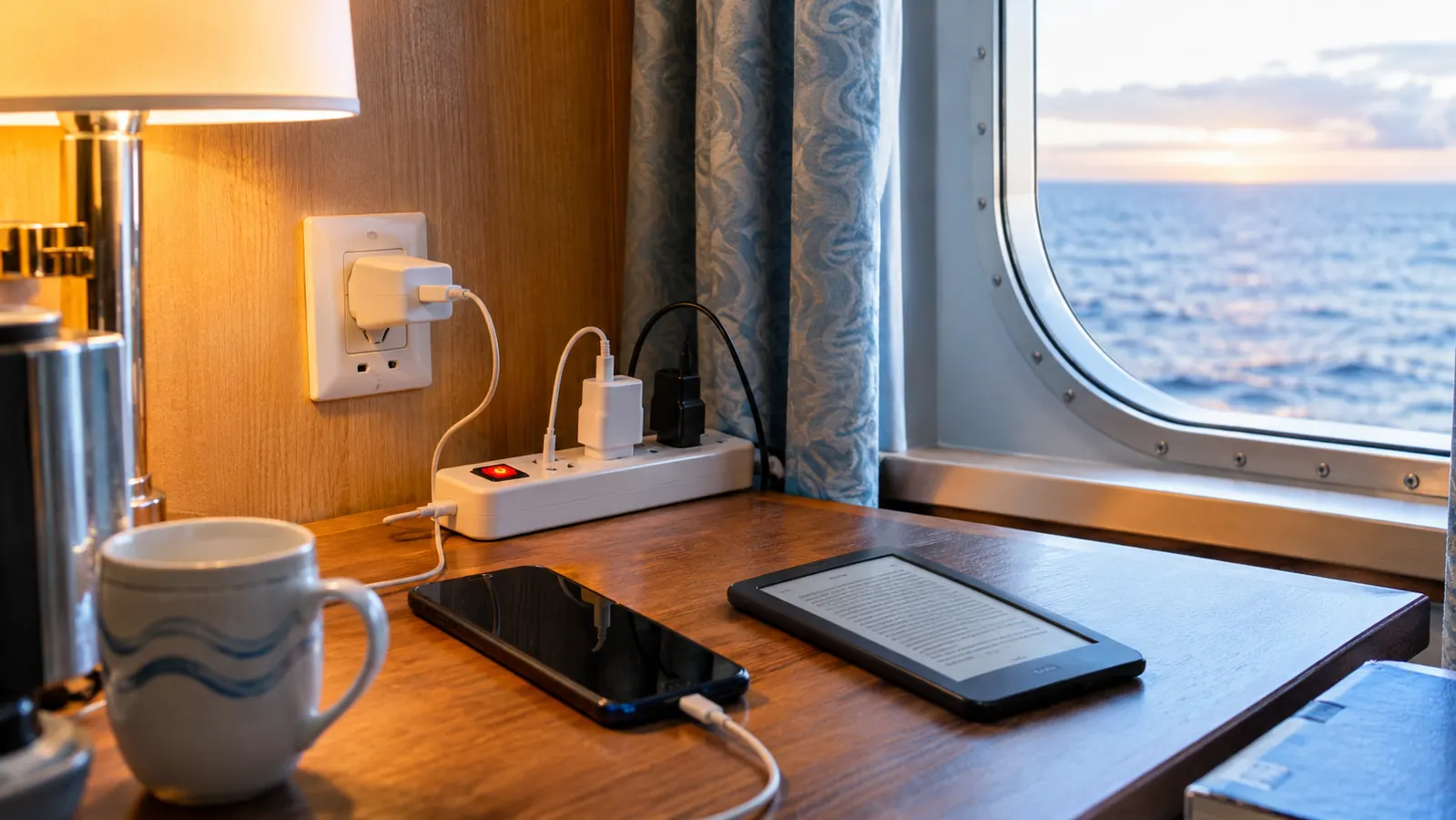
The short answer is that these two strips are not competing for the same job, and once you see that, the decision takes about ten seconds. A surge protector strip guards electronics against voltage spikes and brownouts. The Cruise On Non-Surge Power Strip exists for one narrow reason: to turn the single outlet by a cabin desk into five usable ones without getting flagged at embarkation security. I bought the Cruise On before our tenth cruise. Gus and I have taken it on five sailings since, and it has gone through the scanner without a word every time.
So my answer is blunt. If you are packing for a cruise, buy the non-surge strip and leave the surge protector at home. Not because the surge protector is badly made. Most of them are fine at what they do. You should leave it home because most major cruise lines list surge-protected strips as prohibited items, and winning that argument at the security table is not how anyone wants to start a vacation. If you are setting up a desk at home, or staying in a hotel with one sad outlet behind the nightstand, the surge protector wins and it is not close.
| Cruise On Non-Surge Power Strip | Surge Protector Strip | |
|---|---|---|
| Cruise line policy | Non-surge by design, no cord, built for the lines that publish a prohibited list | Surge protection is on the prohibited list for most major lines |
| Voltage spike protection | None. It splits one outlet into five and does nothing else | Clamps spikes and absorbs them, which is the entire point of the device |
| Outlets | 3 AC outlets plus 2 USB ports, so 5 devices at once | Usually 6 to 12 AC outlets, USB only on some models |
| Cord | No cord at all, plugs flat against the wall | 6 to 15 feet of cord, which reaches across a room |
| Size and weight | 3.5 by 3 inches, 5 ounces | Long and heavy, the cord alone can weigh more than this strip |
| Where it earns its keep | Cabin desks, hotel rooms, the one outlet behind a nightstand | Home offices, workshops, anywhere with expensive electronics |
Where Cruise On Wins
The first win is the one that matters most, and it is not a feature. It is permission. The Cruise On strip has no surge protection inside it, so it does not trip the rule the lines write into their own published lists. Carnival, Celebrity, Princess, Norwegian, Holland America, MSC and Virgin Voyages are all named by the manufacturer as lines this strip is built for. I will not tell you that means every screener on every ship will wave it through, because screening is done by people and people vary. I will tell you that ours has gone through five times and never been confiscated or held.
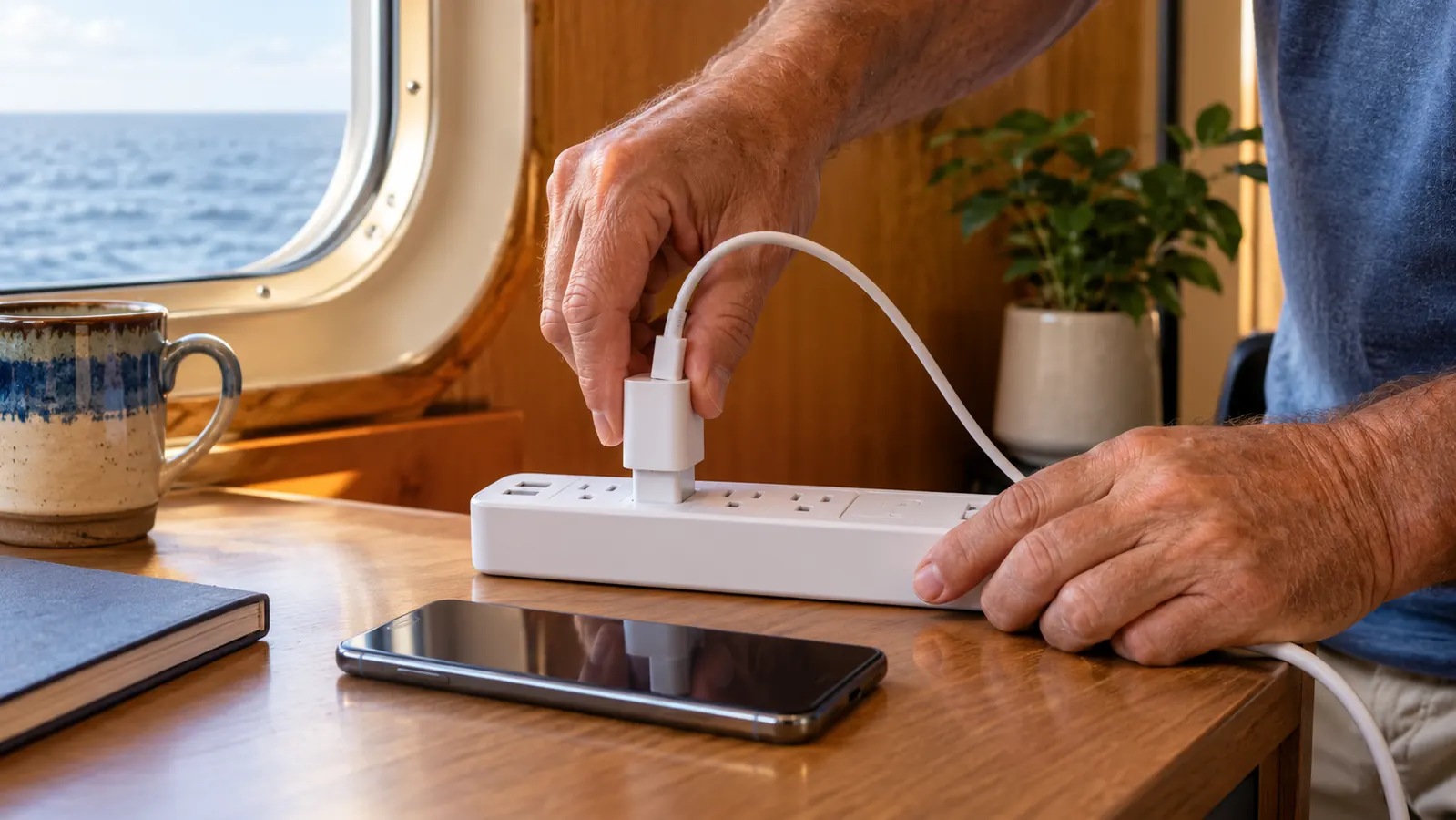
The second win is size. This thing is 3.5 by 3 inches and 5 ounces, and there is no cord at all. It plugs flat against the wall, which matters in an interior cabin where the desk outlet sits low and slightly recessed and the desk itself is also the place you eat, charge, and stack the daily newsletter you will never read. A surge strip with a cord drapes that cord across the desk or hangs it off the side. Ours sits in the corner, holds two phones, my e-reader and Gus's razor, and has never once been in the way. Three AC outlets plus two USB ports is five devices from one socket, which is the whole problem solved. One detail I did not expect: because there is no cord housing sticking out, I could slide the desk lamp over to the wall side and still seat the chair. On an older ship with a deeply recessed socket, a corded plug stuck out far enough that my knee caught it every single time I sat down.
Where the Surge Protector Wins
Here is what the Cruise On cannot do, and I am not going to pretend otherwise. It has no surge protection. None. It splits one outlet into five and that is the entire job. If lightning hits the transformer down the street, or a hotel's wiring does something ugly, this strip will pass it straight through to whatever is plugged in. A surge protector clamps that spike and absorbs it. For a laptop with a year of photographs on it, that is real protection, and no splitter can substitute for it.
The surge protector also simply has more outlets, usually six to twelve, and a cord that reaches across a room. In a hotel where the only outlet is behind the bed, that cord is the difference between charging your phone on the nightstand and charging it on the floor. At home, where weight and packing do not matter, the surge strip is the right tool for a desk with a monitor, a dock, speakers and a lamp. I keep one under my own desk in Melbourne. It has been there since before we started cruising and it is not going anywhere. It is not a bad product. It is the wrong product for a cabin.
Five outlets that clear the scanner instead of getting held at it
3 AC outlets plus 2 USB ports, no cord, 5 ounces, and built for the lines that ban the surge version.
Amazon Check today's price on Amazon →What Security Actually Confiscates
I want to be precise about this, because most of what I read online is vague about it. The item the lines object to is a power strip with surge protection inside it, the kind with the protection component built in and a joule rating printed on the box. The stated reason is fire risk and strain on the ship's electrical system. A plain splitter has no such component, so the rule was never written about it.
In practice, at Port Canaveral, your carry-on goes through the scanner and a person looks at the screen. A tangle of cords reads as cords. A power strip with a brick on one end reads as a power strip, and that is the moment somebody asks to see it. Ours has been looked at, if I am honest. On the second sailing the woman running the machine picked it up, turned it over, read the label on the back, and handed it back. That was the whole event. The label on the back says what it is, and it says it plainly. The woman two places behind me in that same line had a six-outlet surge strip in her carry-on. She was asked to step to a folding table at the side, and she filled out a form while her husband stood there holding both their bags.
The other thing worth knowing is that confiscation is not always permanent. Some lines hold prohibited items and return them at the end of the sailing. On the line we sail most, held items get tagged and stacked in a room near guest services, and you collect them on the last evening between the two dinner seatings. That is still a week without the thing you packed, and it is still a line of forty people on the last night when you would rather be eating. Packing the right item in the first place costs you nothing and takes one decision off the table.
Five Sailings in an Interior Cabin
We book interior or oceanview to keep the fare down, so floor space is a rumor and every surface has to earn its place. The desk in those cabins has one North American outlet, sometimes two if you are lucky, and it sits low, which makes a fat plug awkward to seat. The Cruise On is a Type B three-pin plug rated at 125 volts. It went into the desk outlet on all five ships without an adapter and sat flush enough that I could still push the desk chair in. On the fourth sailing the outlet was set into a shallow cubby under the mirror, maybe four inches deep, and the strip fit with room to spare. I had measured nothing beforehand. I just plugged it in on the first afternoon and it sat there for seven days.
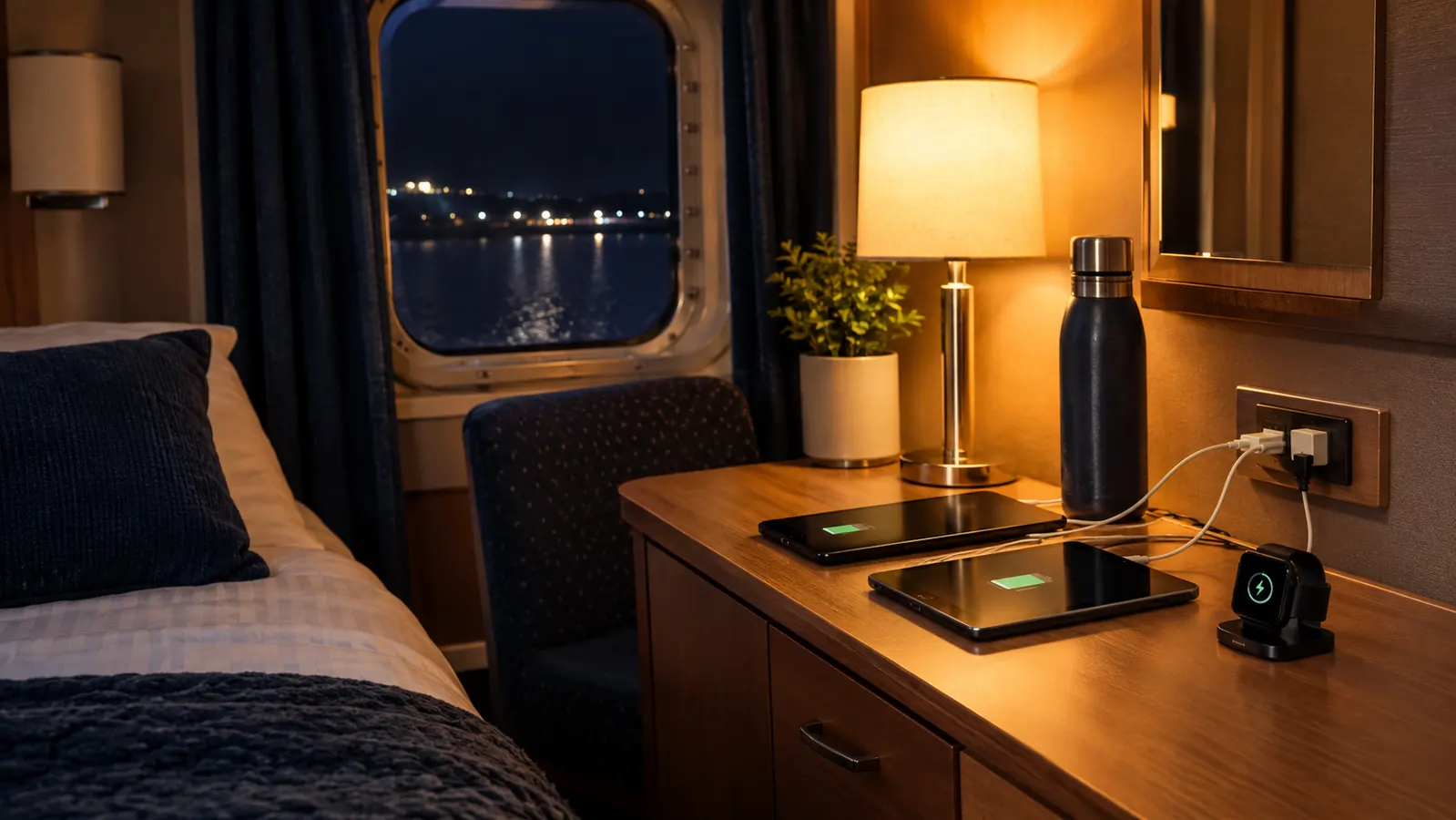
What it actually powers overnight on a typical sailing: my phone, Gus's phone, my e-reader, and his electric razor. That is four devices on a strip that holds five, and it does it while the desk lamp stays plugged in beside it. In the morning the phones come off and the USB ports are free for the camera battery. I charge both phones off the USB ports, which leaves all three AC outlets free for the e-reader, the razor, and whatever else turns up. Gus's razor is the one that surprised me. It draws so little that I never noticed any difference in how fast the phones charged. I have never had the strip run warm, and I have never had it trip anything.
The one rule I follow is that nothing that makes heat goes anywhere near it. No travel iron, no curling iron, no kettle. Those are banned on board anyway, and they are banned for good reason. The strip is for electronics with a charging brick, full stop. That rule is not about the strip being fragile. It is about not being the person who sets off a cabin alarm at eleven at night on a sea day when the whole corridor is asleep.
On the second sailing the woman running the scanner picked it up, turned it over, read the label on the back, and handed it back to me.
What It Cannot Do
It cannot convert voltage. If you are on a ship with European outlets at the desk, this strip will not help you there, and if your itinerary starts with a night in a Barcelona hotel, you still need the plug adapter you were going to pack anyway. It is not a travel adapter and it does not pretend to be one. It is a North American splitter for North American outlets.
It also will not give you more than five outlets. If you travel with two laptops, two phones, a camera, a watch charger and a CPAP machine, five is not enough, and the honest fix is to think harder about what actually has to charge at the same time. What this solves is the ordinary case: two people, two phones each, and one small thing that needs a USB port overnight.
Two Things to Know Before You Pack It
First, look up what your line actually published. Pull up the FAQ page for the line you are sailing and search for the word surge. If the prohibited list names surge-protected power strips, you are exactly the person this comparison is written for. Save a screenshot to your phone, not because you plan to argue with anyone, but because a screenshot ends a conversation faster than a description does.
Second, bring short cables. The strip sits flat on the desk, so a six foot charging cable ends up coiled in a nest beside it, and a nest of cable on a cabin desk is how you lose a hair clip and a room key. Three foot cables reach from the desk to the bunk shelf with nothing left over. I switched after the third sailing and have not thought about it since.
Who Should Buy Which
Buy the Cruise On Non-Surge Power Strip if you are sailing on Carnival, Celebrity, Princess, Norwegian, Holland America, MSC or Virgin Voyages and you want one desk outlet to become five. Buy it if you pack light, if your cabin is interior or oceanview, and if you would rather not spend the first hour of your vacation standing at a security table. It is also the right pick for a hotel room with one outlet in an awkward place, because 5 ounces and 3.5 by 3 inches takes up less room in a tote than a paperback. I am not a gadget person by nature. I am a person who once packed a three-outlet cube with a short cord and spent a week stepping around it on the floor. The difference between that cube and this strip is roughly the difference between a tool that fits the room and a tool that fights it.
Buy the surge protector strip if the devices stay home. A desk with a monitor, a dock, speakers and a lamp wants a surge strip with a cord and six outlets, and it wants to live there permanently, screwed to the underside of the desk or shoved behind it. Buy one for a driving trip too, if space is not a constraint, because the protection is real. Just do not put it in the cruise bag. That is the whole decision, and it took less time than reading this far.
The strip that has already cleared security five times
No surge component, no cord, 5 ounces, 3 AC outlets and 2 USB ports. Pack it once and stop thinking about it.
Amazon See it on Amazon →