
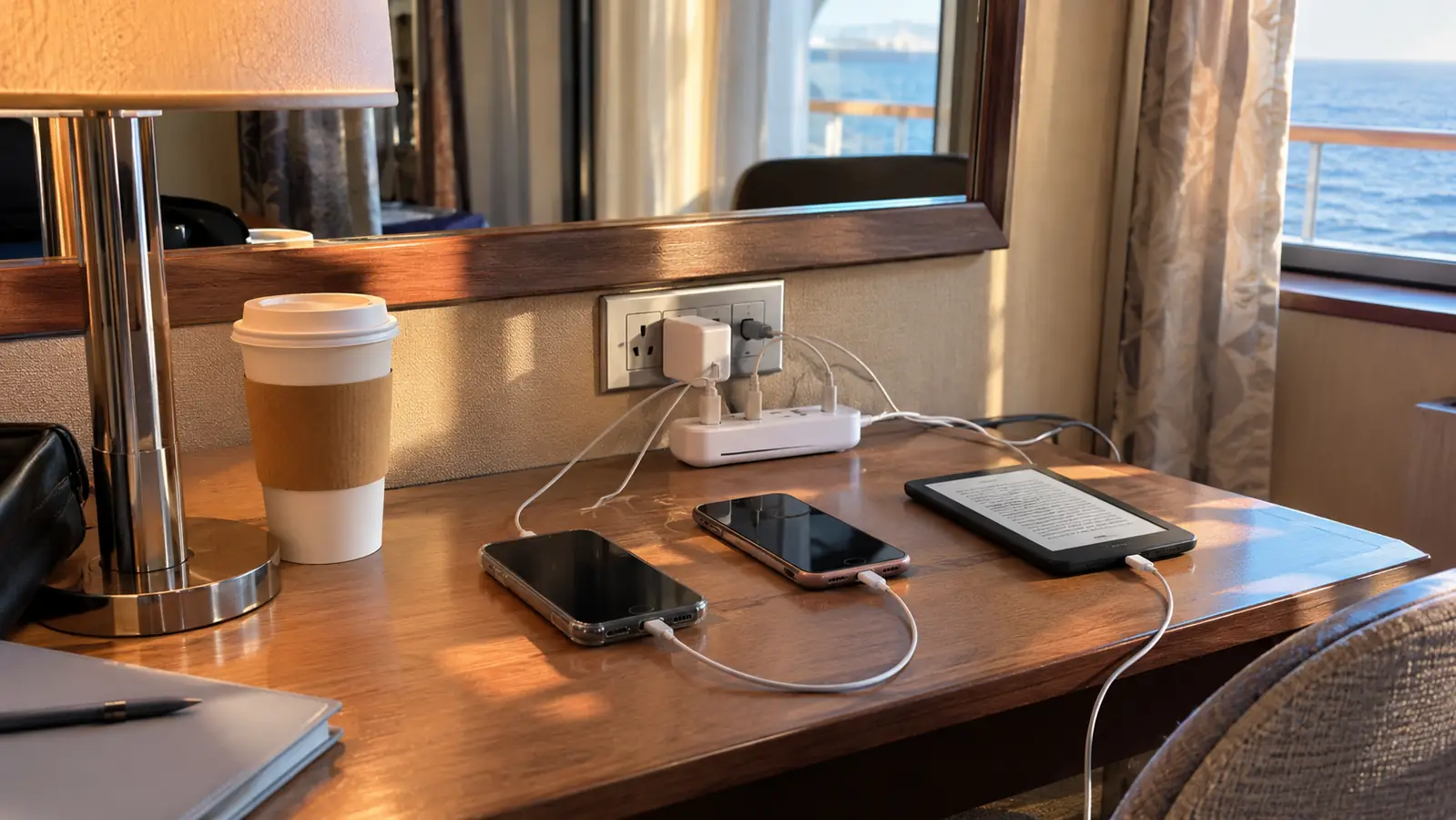
The first night of a cruise is supposed to be the relaxed part. For us it is the hour Gus and I spend hunched over the desk in an interior cabin, holding two phones, an e-reader and an electric razor, negotiating over one outlet the way people negotiate over the last parking spot at the port. On our eighth sailing I unplugged the desk lamp so his razor could charge before dinner. He shaved in the dark and did not complain, which was somehow worse than if he had.
Before our tenth cruise I bought a Cruise On non-surge power strip, the compact one with two USB ports and three AC outlets, and it has sailed with us five times since. It lives in my carry-on tote on embarkation day, sits on the desk all week, and has never been pulled out at security for a second look. That is the whole reason I bought it. The rest of it is unremarkable in the best possible way. It is a small housing with five places to plug something in, and it has quietly retired the pouch of mismatched wall adapters I used to carry.
Five Sailings, One Strip, No Lectures at the Pier
The Cruise On strip runs two USB ports and three AC outlets off a single cabin socket, built without a surge protector and without an extension cord. It has cleared embarkation security five times for us.
Amazon Check Today's Price on Amazon →Step 1: Count the outlets before you pack a single charger
Cabin outlet counts vary more than people expect, and the deck plan will not tell you. On the older ships we have sailed, the desk had one usable outlet and the lamp had the other. On a newer ship there were two at the desk and a third low on the wall by the bed. The bathroom has one too, but it is labeled for shavers, and a wet counter is not where I want a phone charging overnight while I sleep.
Do the arithmetic before you zip the bag. Two phones, an e-reader, an electric razor, a camera and a watch is six things that want power, and almost all of them want it at night. You are not going to find six outlets. You will be lucky to find two. That is the entire argument for a strip instead of a pouch of wall adapters, which is what I used to bring and which solved nothing at all. Adapters do not make more sockets. They just make a mess of the desk.
Check the plug and the voltage for the itinerary while you are at it. A sailing out of Port Canaveral runs on North American current. A Mediterranean sailing out of Barcelona does not, and a 125 volt strip is not a converter. Ask the cruise line before you assume, because the wrong assumption does not announce itself until you are standing in your cabin with a dead phone and a plug that does not fit.
Step 2: Buy non-surge, and treat the word as the whole point
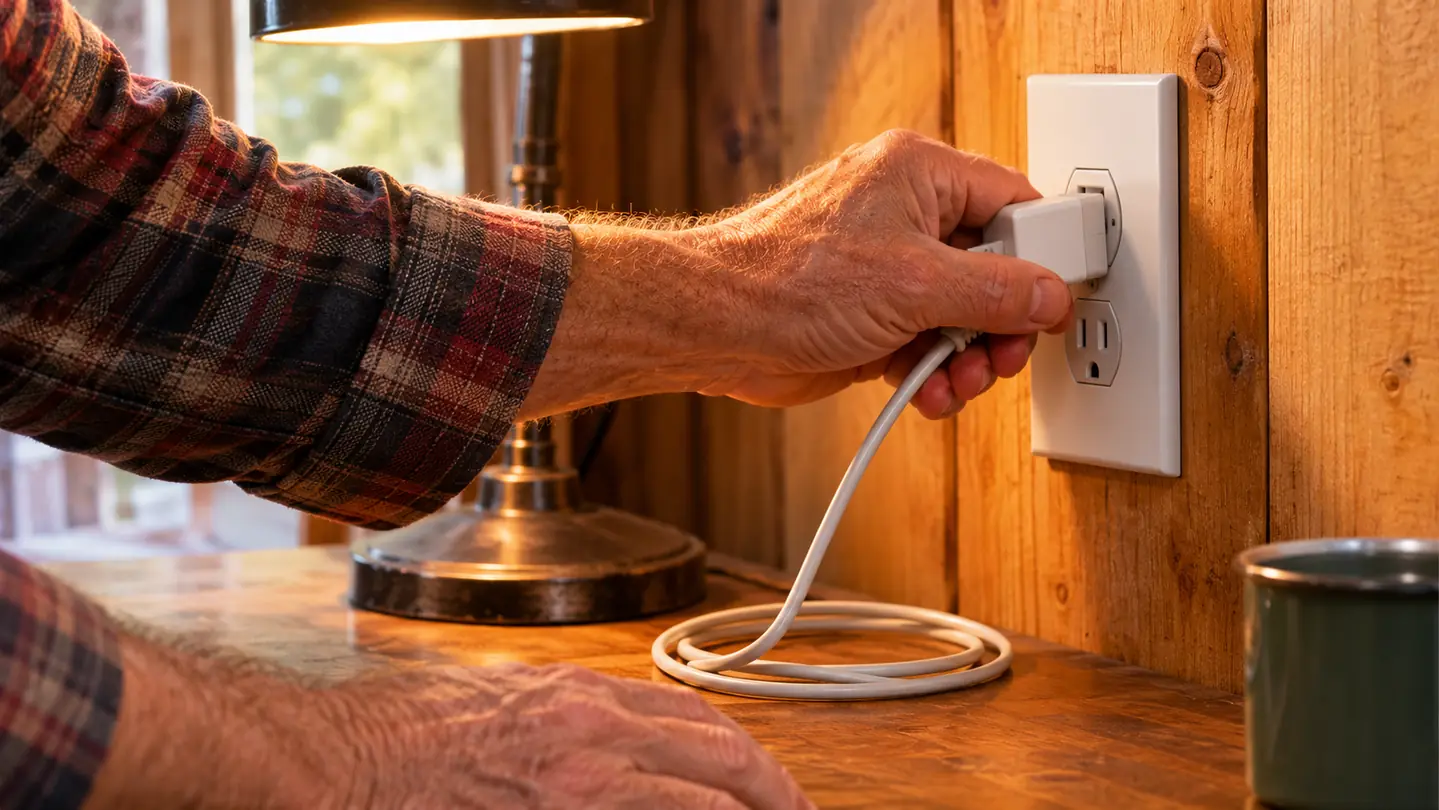
The rules single out surge protectors. That is not a suggestion, and it is not a matter of which security guard is working the pier that morning. A surge protector gets taken, and you do not get it back. The Cruise On strip is built without one, and it also has no extension cord, which is the other detail that draws a second look at the scanner. Those two omissions are the product. Everything else is a small housing with five places to plug something in.
What you actually get is three AC outlets and two USB ports, which is five devices off one socket. It measures 3.5 inches by 3 inches and weighs 5 ounces, about the same as a deck of cards in my hand. It runs on 125 volts with a standard three-pin North American plug. There is nothing to set, no display, no mode to choose. You plug it in and it works, which after a travel day is exactly as much complexity as I want from anything I have to operate before dinner.
The limits deserve saying out loud. It is not a voltage converter. It is not for anything that makes heat, and an iron, a curling iron or a hair dryer is banned on the ships anyway. It charges two phones, an e-reader, a camera battery and an electric razor, and it does that from a single socket without a tangle of adapters spreading across the desk like a dropped plate of spaghetti.
Step 3: Pack it where it will not become a conversation
Put it in your carry-on, not the bottom of the checked suitcase, and put it somewhere you can reach without unpacking half the bag. The one time I was asked about it, I held it up, said the word non-surge, and that was the end of it. If it is buried under three days of clothes, you are the person holding up the line at eleven in the morning with two hundred people behind you.
Keep it in a small pouch with the chargers so it comes out as a set and goes back in as a set on the last night. That one habit is why I have stopped leaving cables in cabin drawers. Nobody at the pier needs to see the box or the paperwork. What they need to see is a small strip with no cord and no surge protector inside it, and then they wave you through and you go find lunch.
One more packing note, learned the hard way. Do not put the strip in the same pocket as your liquids and do not wrap it in a beach towel, because both of those turn a four second answer into a five minute bag search. Top of the tote, flat, in the pouch, next to the chargers it belongs with. That is the whole filing system and it has not failed me yet.
Step 4: Set up the charging station the afternoon you board
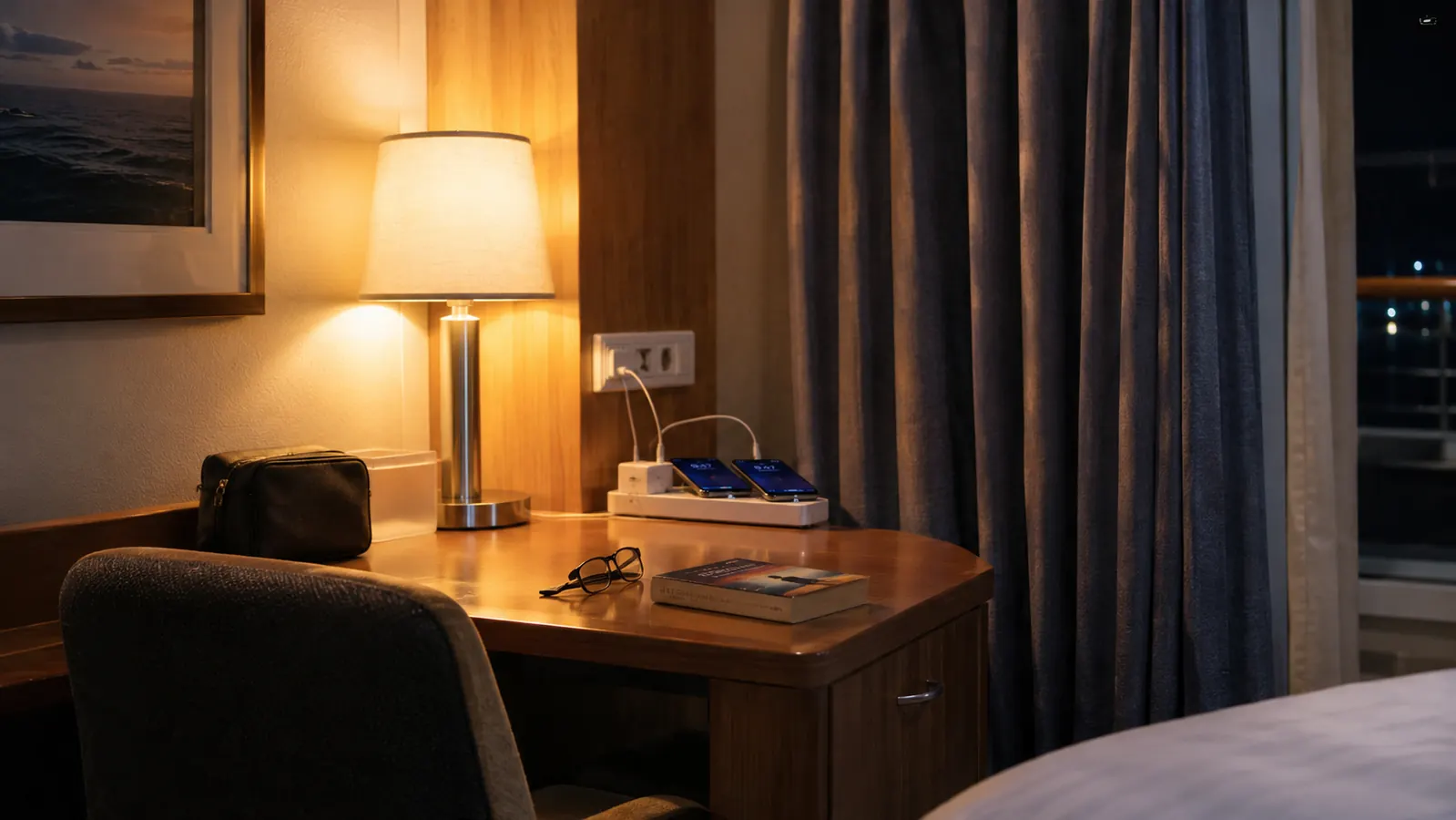
Unpack the electronics while the ship is still in port and the cabin is quiet. Plug the strip straight into the desk outlet, set it flat at the back, and route the cables behind the lamp instead of across the desk. On a desk the size of a serving tray, a strip sitting flat at the back leaves the front clear for the things you actually use all week, which for us is a paperback, a pair of glasses and a cup of tea going cold.
Do not put it on the bed, do not balance it on a shelf, and do not leave it on the bathroom counter. Keep it dry and keep it out where you can see it. Do not chain a second strip or an adapter into it either. One strip, one socket, five devices. That is the entire setup, and it takes about four minutes, most of which is spent untangling the charging cable Gus wound around his phone in the car.
Gus's razor goes on an AC outlet and stays there for the week, so it is always ready when he needs it. The phones go on the two USB ports at night. A camera battery or a watch charges during the day when nobody needs the desk. By the second day you stop thinking about it entirely, which is the sign of a travel gadget that earned the space in the bag and the small amount of attention it demands on day one.
Step 5: Build a routine that survives a port day
The habit that makes this work is not complicated. Phones on the strip when we come back from dinner, off in the morning. Razor every other night. The e-reader whenever it drops below half, because I read in the afternoon with the cabin lights low and I do not want to be hunting for a charge at ten at night with a book I have already started. Every device has a place, and nothing lives on the floor where I will step on it in the dark.
Unplug the strip when you leave for a long port day, the same way you would unplug anything else you are not using. On the last night everything comes off, the strip goes back in the pouch, and the pouch goes in the tote. Fifteen seconds of work, and I have not left a charger behind in a cabin since I started doing it this way. Before that I lost a cable on two different ships and never saw either one again.
Five sailings in, this is the least interesting piece of gear I own and the one I would replace first if it broke. That is the highest compliment I can pay a travel accessory. Nobody has ever asked me about it on board. It just sits at the back of the desk doing its one job while we are out at a show or in port buying a hat we do not need.
What Else Helps
The strip solves power. It does not solve the rest of a small cabin, and there are three other things that come out of my bag on every trip. The Neosmuk magnetic hooks are the first. Cabin walls and ceilings are metal, so a hook sticks wherever you put it. Two by the door for lanyards and hats, two in the bathroom for a toiletry bag and a wet swimsuit, three on the wall for day bags and Gus's jacket, one by the bed for my glasses case. Ten go up, ten come down. We count them on the last night and we have never lost one.
The JOTO pouch and the packing cubes earn their space as well. The pouch has been in the water in Cozumel and on the pool deck, and it still passes the paper towel test in a sink before every trip. The cubes turn two suitcases into about ten minutes of unpacking into drawers the size of shoeboxes. And for Gus, the Sea-Band wristbands go on the night before we sail. He finds they help him on the rougher days. Anyone dealing with real seasickness should talk to a pharmacist or a doctor about medication, not take advice from me.
If you want the longer version, I keep two sets of notes that go deeper than this page: how the Cruise On strip has held up over five sailings, and how it compares with the ordinary surge protector you might already have in a drawer at home. The short version is that the strip has done exactly what it promised, and the surge protector should stay home, where it can protect a television instead of getting confiscated on a pier in Florida.
Five sailings, five trips through embarkation security, and not once has anyone opened the bag to ask about it.
One Socket Is Enough. Pack Like It.
Two USB ports, three AC outlets, no surge protector and no extension cord. If your cabin has one outlet and your bag has four chargers, this is the fix.
Amazon Check Today's Price on Amazon →