
Short answer first, because I know why you are here. If you get queasy on a ship and you want something you can buy without an appointment, keep in a toiletry bag and wear all week, the Sea-Band wristbands are the pair that live in our suitcase. If you want one thing you apply once and then forget about, and your doctor is willing to write the prescription, the motion sickness patch does that job better. My husband Gus is the queasy one in this marriage. He has used both on real sailings, in weather that was not kind, and he has opinions about which one earned its place.
Some background, so you can weigh the rest. We have sailed 14 times since 2009, mostly four and seven night Caribbean runs out of Port Canaveral, plus Alaska out of Seattle in 2019 and the Mediterranean out of Barcelona in 2023. We book interior or oceanview cabins to save money, so everything has to earn its space inside one medium suitcase. I do not get seasick. Gus does, mostly on the first sea day and mostly when the ship settles into that slow roll nobody warns you about. That is why these two items keep turning up in our cabin, and why I have watched both of them work, and fail, at close range.
How the Two Actually Work
The Sea-Band pair works by pressure. Each band presses on the P6 point on the inside of the wrist, a spot that acupressure tradition ties to nausea. You wear one on each wrist, you feel a light steady pressure, and that is the whole thing. The listing says it plainly: pressure on the P6 point, inspired by traditional remedies, no drugs involved. Whether it works for you is a personal question with a personal answer. It works for Gus often enough that he keeps wearing them. I have also watched them do very little for a stranger at the next table on a choppy afternoon, and I have watched them take the edge off for Gus on the same kind of day.
A motion sickness patch works the other way. It is a small adhesive disc that goes behind the ear and releases medication through the skin over a stretch of days. The common one in the US is scopolamine and it needs a prescription. It is not subtle. It changes how your body handles the signals coming from your inner ear, and it keeps doing that while it is on, including while you sleep. That is why one patch can cover several days, and it is also why the side effects are real. Nobody puts one on for fun.
| Sea-Band Wristbands | Motion Sickness Patches | |
|---|---|---|
| How it works | Pressure on the P6 point on each wrist | Releases prescription medication through the skin behind the ear |
| Before you sail | No head start needed, put them on any time | Typically needs to go on several hours before travel |
| Attention mid-cruise | You notice them, and a long sleeve can shift one | Applied once, then forgotten for about three days |
| Side effects | Drug free, no dry mouth or drowsiness to manage | Dry mouth, drowsiness, sometimes blurry vision |
| If nausea has already started | Little help once you are actively sick | Medication can still do something at that stage |
| Getting hold of it | Over the counter, no appointment | Prescription required in the US |
| Reuse | Reusable and washable, one pair across many trips | Single use, one patch per dose period |
| Space in the bag | About an ounce for the pair | A flat foil pouch of roughly the same footprint |
| Best for | Mild to moderate queasiness and a drug free routine | Known bad sailors and long stretches of open water |
Where Sea-Band Wins
The bands take three categories, and every one of them matters when you are packing a cabin the size of a walk-in closet.
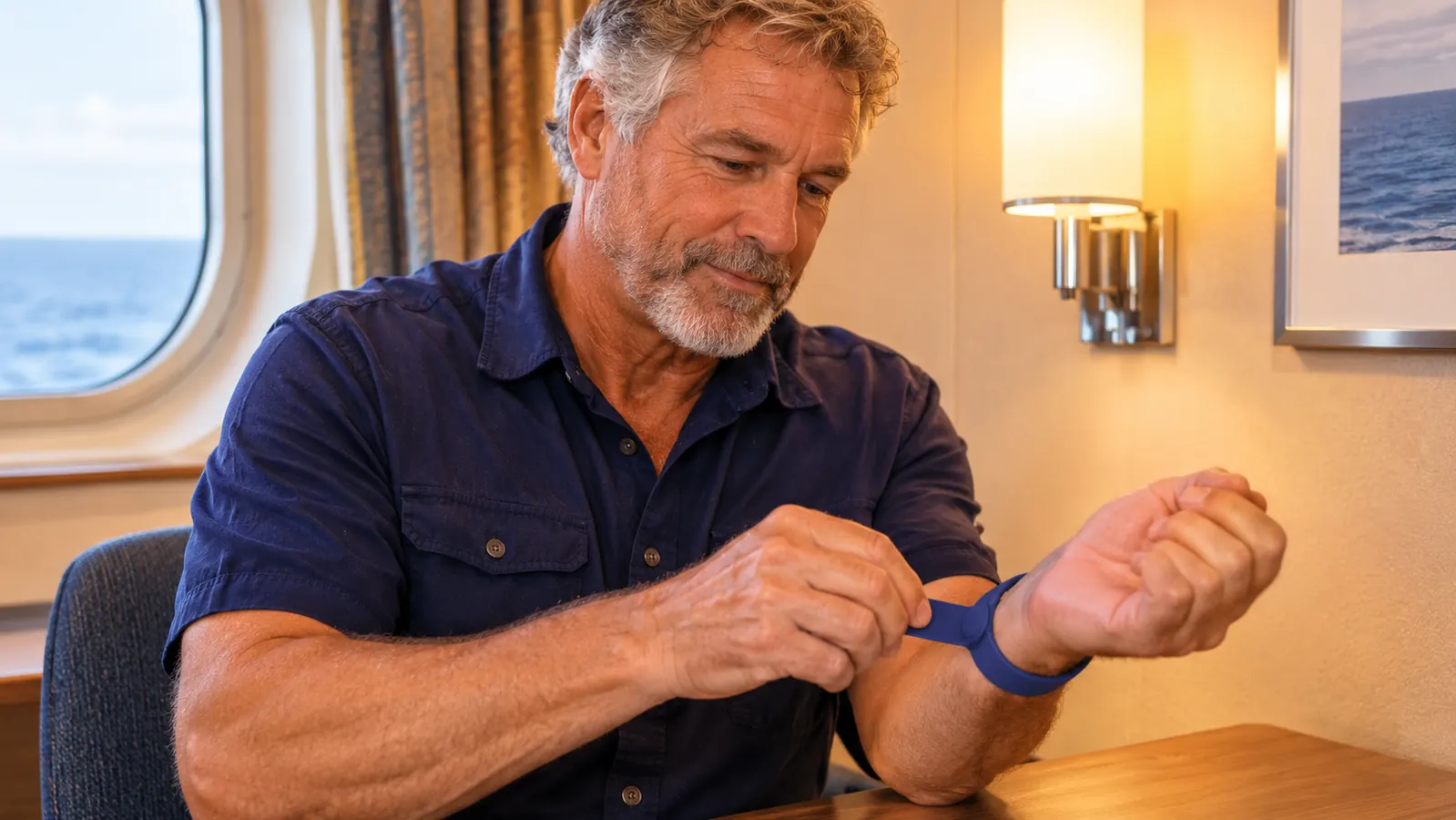
The first is timing. Our patch came with instructions to put it on several hours before travel, which meant setting an alarm on embarkation morning and remembering it somewhere between the taxi and the muster drill. The bands have no such rule. Gus puts his on the night before we sail, sleeps in them, and they are doing their job when he opens his eyes. If he forgets, he can put them on in the terminal ten minutes before boarding and they still do what they do. There is no build-up and no window to miss, and on a travel morning that is worth a lot.
The second is what is in them, which is nothing. Gus takes blood pressure medication, and adding a second drug to that mix is not a decision either of us wants to make in a hurry. The bands are drug free, so there are no interactions to check and no pharmacist conversation required before every trip. On the patch he had a dry mouth for three days and slept through an entire afternoon while the ship was in port. The bands have never done that to him. He is alert, he eats dinner, and he plays trivia badly, same as always.
The third is that they are reusable and washable. Ours have been on seven sailings. Gus rinses them in warm water with a little hand soap, sets them on the bathroom shelf to dry overnight, and they go back in the pouch. Nothing else in our travel kit has that record. There is also no prescription and no appointment. You add them to the order, they arrive, they go in the bag. If your doctor is hard to reach before a sailing, that is a real advantage. The listing notes they are HSA and FSA approved, which is a small practical bonus if you keep an account like that.
Where Motion Sickness Patches Win
I will give the patch its due, because on a long sailing it does something the bands cannot. One patch behind the ear is typically dosed for about three days. Gus put one on in Seattle and, apart from a shower, he did not think about nausea again until we were most of the way down the inside passage. The bands always involve a little attention. You feel them. A long sleeve can drag one out of position. You take them off to shower, or you leave them on and wonder about it, and either way it is a decision. The patch removes the decision entirely.
The other place the patch wins is after the day has already gone wrong. On a February crossing out of Port Canaveral the sea got up on the second afternoon and Gus was sick before he had a chance to do anything about it. The bands were already on both wrists. They did not save him. Pressure on a wrist is not medication, and once you are actively vomiting a wristband is not going to change the weather. I think that is the honest limit of them and it bothers me when they are sold as a cure. A patch is a drug, and a drug can still do something at that stage. If you know you are a bad sailor, or you are crossing an ocean instead of hopping to the Bahamas, that difference is worth taking seriously.
The patch is not free of consequences, and this is where the comparison gets fair again. It needs a prescription in the US, so it is not something you pick up the night before because you saw a forecast you did not like. Dry mouth is common and it is not small. Drowsiness is common too. Some people get blurry vision. You are supposed to wash your hands carefully after you handle it and keep your fingers away from your eyes, and you cannot cut one in half to try a smaller dose. It is medication, and medication comes with rules. I am not a doctor and I am not going to play one here. Gus asked our pharmacist, and that is exactly what I would tell anyone else to do.
The bands are the everyday answer. The patch is the insurance policy. Neither is a cure, and anybody who says otherwise has not spent a night in a forward cabin in a beam sea.
The pair that has been in the toiletry bag for seven sailings
Drug free, reusable, and rinsed in the bathroom sink between ports. Sea-Band presses on the P6 point on each wrist, needs no head start, and takes up about an ounce in the suitcase. Gus wears his from the night before embarkation. If your motion sickness is serious, talk to a doctor or pharmacist as well.
Amazon Check Today's Price on Amazon →
What Seven Sailings Actually Looked Like
Here is the routine, since the routine is the review. The night before embarkation the bands go on, one on each wrist, and they stay on through the drive to the port, the muster drill and dinner. On port days Gus takes them off, rinses them and puts them back on before we sail. On a flat sea day he forgets he is wearing them. That is the highest compliment I can pay a small piece of travel gear, and it is the reason they keep coming back out of the suitcase.
The night that sticks with me was the run back from Cozumel. The ship was moving in a way that had half the dining room studying their plates. Gus had the bands on and he was not himself, but he was upright and he ate most of his dinner. The next morning he said he would not want to do that crossing without them. He also said he would not want to do it without a patch in the wallet, just in case. I think that is the correct answer, and it is not the answer a seller wants to hand you.
The care is genuinely simple. Warm water, a drop of soap, pat them dry on a towel and let them air out overnight. Ours have not stretched out or frayed in seven trips. I have worn them myself on a tender boat out of Grand Cayman, not because I get seasick but because the ride out to the reef was rough and I did not want to find out the hard way. They also work on the flight down and the drive to the port, which is more than you can say for a patch, since that is usually saved for the sailing itself.
What I Liked
- Drug free, so there are no interactions to check
- No head start needed, you can put them on any time
- Reusable and washable, one pair across many trips
- Over the counter, no appointment and no prescription
- About an ounce for the pair and it folds flat in a toiletry bag
Where It Falls Short
- Will not do much once nausea has already started
- A long sleeve can drag one out of position
- You feel them on your wrists, and some people dislike that
- Relief varies a great deal from person to person
Who Should Buy Which
Buy the Sea-Band pair if you are a mild to moderate sailor who wants something drug free in the toiletry bag, or if you take medication and would rather not add another one to the list, or if you want something that also works on the flight, the drive and the tender boat. Buy them if you are the packer in the family and you like the answer being in the suitcase before anyone feels bad. One pair, one small pouch, seven sailings and counting, and the only maintenance is a rinse in the sink.
Ask your doctor about a patch if you know you are a bad sailor, if you are doing a crossing or a long stretch of open water, if you have been sick on the first day of a cruise before, or if you tried the drug free route first and it was not enough. The patch is the heavier tool and it needs planning, because you have to get the prescription filled before you leave and put it on hours before you sail. It is also the thing to reach for when you are already in trouble, provided you have talked to someone about it in advance.
Plenty of people carry both, and after watching Gus on that February crossing I understand why. The bands handle the ordinary days and the flight home. The patch sits in the wallet as the answer to the one day the bands cannot cover. If you are prone to serious motion sickness, talk to a doctor or pharmacist before you sail rather than after, because the middle of the Caribbean is a poor place to discover that you needed a plan.
One pair, seven sailings, a rinse in the sink between trips
Sea-Band is drug free, reusable, and small enough to forget about until you need it. If your queasiness is mild to moderate, start here. If it is not, ask your doctor first and keep the bands as the backup in the toiletry bag.
Amazon Check Today's Price on Amazon →