

The first night out of Port Canaveral is where I learned what seasickness actually costs. We were a few hours into a December sailing, not even out of the channel, and Gus had gone quiet in that specific way that means he is calculating how far the bathroom is. Fourteen cruises later I can tell you the fix is not one thing you buy. It is a short sequence of things you do before the ship ever moves, and the Sea-Band wristbands are the part of that sequence that lives in my carry-on tote, every single time.
Most people wait. That is the mistake. They wait until the second morning, when the ship is in open water and the dining room feels very far away, and then they go looking for help in the gift shop. By then Gus is not interested in instructions, he is interested in lying still in a dark cabin. The five steps below are the order we actually do things in, tested across seven sailings since we bought that first pair for our eighth cruise. None of it is complicated. All of it has to happen earlier than you think, and the earlier you start, the less of your holiday you spend lying down.
The one thing in my tote before every sailing
One pair, one ounce, and Gus puts them on the night before we leave the dock. Not a cure. But the difference between a rough afternoon and a lost day at sea.
Amazon Check Today's Price on Amazon →Step 1: Have the Conversation Before You Pack
This is the unglamorous step and the one I would not skip. Before our eighth cruise I asked the pharmacist at our CVS in Melbourne what she would suggest for a 64 year old man who goes queasy on the second day out. She walked through the options, told us what interacts with Gus's blood pressure medication, and mentioned acupressure bands as the drug free thing worth trying first. That conversation took ten minutes and we walked out knowing more than we did going in.
Before that we had tried two things that did not work. The first was a packet of chewable tablets from the ship's gift shop on an earlier sailing. They made Gus drowsy by ten in the morning and did nothing for the queasiness underneath, so he slept through an afternoon he had been looking forward to. The second was a coiled plastic band from a boating supply shop back home, sized for a much smaller wrist. It dug in after an hour and left a red line he could still see at dinner. Neither one made it onto the next packing list.
The bands themselves are small. One pair, one ounce, listed at 0.75 by 2.4 by 5.2 inches. That is small enough that there is no reason to leave them home, and small enough that you should probably own them for more than one trip. They are reusable and washable, which matters more than it sounds on a seven night sailing where everything you brought starts to smell faintly of the sea.
One more thing about packing. Ours go in the top zip pocket of my tote, never in the checked spinner. If Gus needs them on embarkation day, and he sometimes does, I am not standing in a corridor at four in the afternoon waiting for a suitcase to appear outside a cabin door.
Step 2: Get the Fit Right and Find the P6 Point
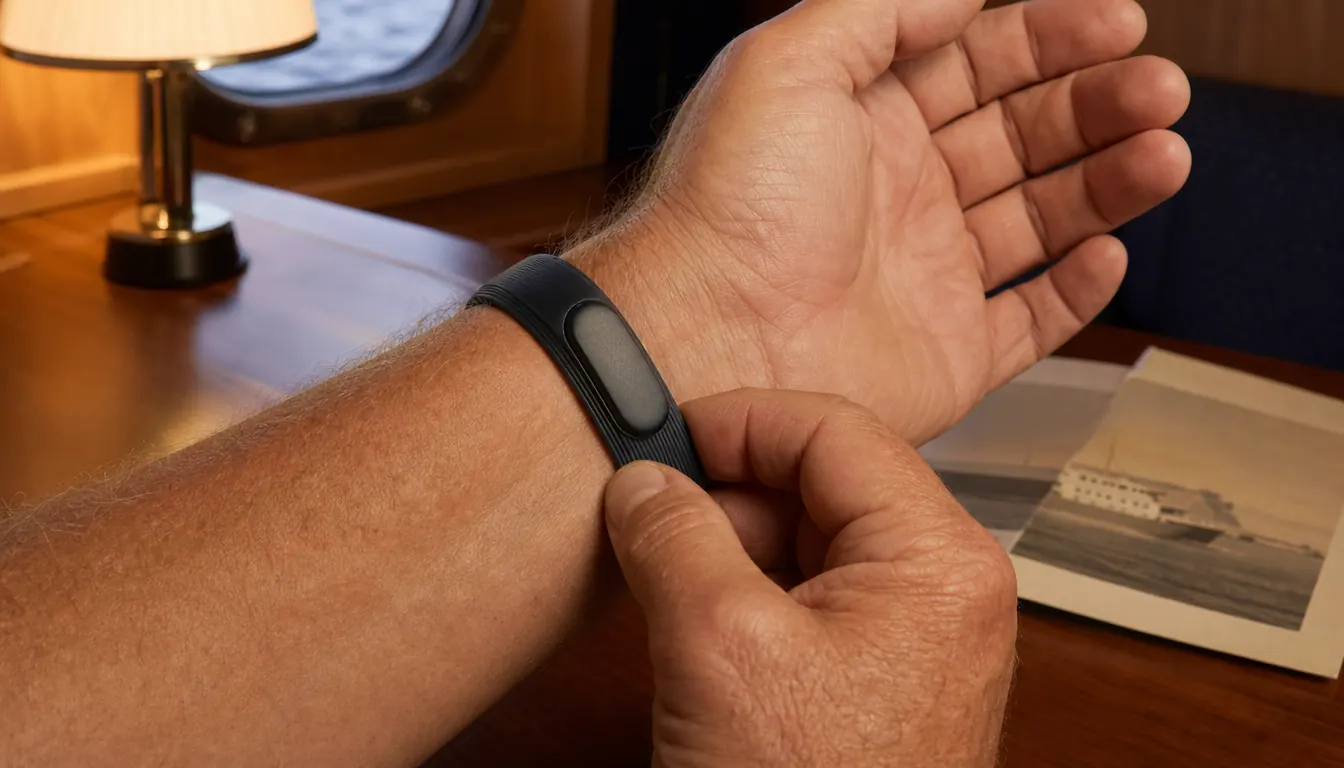
The Sea-Band works by pressing on the P6 point on the inside of each wrist, roughly three finger widths up from the crease where the hand meets the arm, between the two tendons. You do not need to be precise to the millimetre, but you do need to be in the neighbourhood. Set the band so the stud sits on that spot, snug enough that you feel steady pressure, loose enough that it does not leave a deep mark after an hour.
Gus got this wrong for the first two sailings. He had them sitting too low, closer to the heel of his hand, and he swore they did nothing at all. On the third trip I slid them up and the difference was noticeable inside twenty minutes. Whether that was the placement or his mood I honestly cannot say, but we have kept the higher placement ever since.
The fit check is simple. Slide a finger under the band. If it goes in easily, it is too loose. If the hand starts to tingle or the skin goes white, it is too tight. Take it off, let the wrist breathe, put it back on. Both wrists, always. The listing is for one pair, so there is no reason to wear just the one.
What I do now is set both bands before we leave the house and check them again in the cruise terminal, because the elastic relaxes a little once it has been on and off a few times. On the third sailing, the one where we finally got the placement right, I had Gus put them on and then walk a lap of the corridor and report back. Twenty minutes in he said the pressure had settled into something he could ignore. That is the test. Something you notice every thirty seconds is set wrong.
Step 3: Put Them On Before You Feel Bad, Not After
This is the whole trick and it is the step most people skip. Gus puts his on the night before embarkation, in the hotel room or at home in Melbourne, while the suitcase is still open on the bed. He wears them to the port, through the line, through the safety drill. By the time the ship pulls away from the dock he has had them on for a stretch and is not thinking about them anymore.
I know how that sounds. It sounds like superstition. There is a practical reason too: if you wait until you feel queasy, your judgment is already going, and fiddling with a small band on a moving ship while your stomach turns is a miserable job. Do the fiddling on solid ground, with a mirror, in a room that is not rocking.
He takes them off at night and rinses them in the sink with a bit of hand soap, then puts them back on in the morning on days when the forecast looks lumpy. In port, on flat water, he leaves them off. They are reusable and washable, and after seven sailings our Sea-Band pair still looks much as it did in the box, which is more than I can say for most things that live in a suitcase.
The bands do not stop the ship from moving. What they do is take enough of the edge off that Gus can sit at a table and eat breakfast instead of lying in a dark cabin waiting for the day to pass.

Step 4: Build the Rest of the Day Around Them
Bands are one input. The other inputs are free and matter just as much. Gus eats something small and plain before we leave the cabin, even when he does not feel like it, because an empty stomach on a moving ship is a bad combination. Crackers, a banana, dry toast. Then he gets outside, air on his face, before the day gets away from him.
Fresh air and a fixed horizon. That means the promenade deck, or a chair on the side of the ship where he can see the line where the water meets the sky. Not the lounge in the middle of the ship with no windows, however comfortable the chairs are. On our Alaska sailing out of Seattle this mattered more than on any Caribbean trip, because the inside passage days were long and grey and everybody was inside.
There was a sea day on a Caribbean run a few years back where the wind came across the deck hard enough that the promenade was closed at one end. Gus found a chair on the sheltered side, put his hood up, and watched the water for the better part of an hour while I read. He ate a proper lunch afterwards. Two sailings earlier, on the same sort of day, he would have been in the cabin by eleven. Same man, same bands, different routine around them.
We also book lower and midship when we can. An interior cabin on deck two or three moves less than a balcony on deck ten, and I will take a boring cabin over a pretty one if it means Gus sleeps through the night. The trade is that we spend more time in the public areas, which suits us fine. We have never once regretted booking the cheaper cabin.
Step 5: Know When Bands Are Not Enough
I want to be straight with you here, because I have read enough reviews that were not. Sea-Band is not a cure. It is a drug free product that applies pressure to a point on the wrist, and it helps some people and does nothing for others. It is not a medical treatment and I am not a doctor. If motion sickness genuinely disrupts your trips, or you are pregnant, or you take prescription medication, ask your doctor or pharmacist before you lean on a wristband.
Gus carries a backup tablet, prescribed by his own doctor, for the nights when the ship is really working. On our second sea day in the Mediterranean in 2023 the wind got up and he took one. He still wore the bands. He is not precious about it and neither should you be. A band and a backup plan are not in competition with each other.
If you are unsure, every ship has a medical centre and a nurse who has seen this a thousand times. On our Alaska sailing a woman at the next table asked the dining room steward for help and he had her talking to the medical team inside twenty minutes. That is a conversation worth having, and a better use of your morning than sitting in a cabin with no signal trying to work it out alone.
And if the bands are doing nothing for you, take them off and stop wearing them. There is no prize for stubbornness. Some people feel a difference in twenty minutes, some feel nothing at all, and both of those are normal. What matters is that you have something that works before you are three days from the nearest port.
What Else Helps
A few smaller things that have earned their place in our routine. Green apples and ginger, both of which the dining room will hand you if you ask nicely. Water, more than you think, because dehydration makes everything worse. A seat facing forward, and the middle of the ship rather than the ends. A dark, cool cabin for an afternoon nap, which is not a failure of character, it is just what a rough day costs.
The other thing that helps is having your kit in one place. Ours lives in a zip pouch in my tote alongside the waterproof phone pouch and the magnetic hooks we use to hang lanyards by the cabin door. Nothing gets hunted for at the last minute and nothing gets left in a drawer on the final morning. That is the whole system, and honestly it has not changed since cruise eight.
One last note, and this is the part I would say to anyone on their first sailing. The ship will move. You are not going to out-plan the ocean. What you can do is stack the odds: have the conversation, get the fit right, put the bands on early, spend your day in the air, and know what your backup is. Do those five things and a rough patch becomes an inconvenience instead of a ruined week. That is the most any of us can ask for.
Seven sailings, one small pair of bands
Gus still puts them on the night before we leave the dock. If motion sickness has ever cost you a day at sea, this is the simplest place to start, and the least dramatic.
Amazon Check Today's Price on Amazon →