
The first phone I ruined on a cruise did not drown in the ocean. It died one deck above the water, on a lounge chair, from a splash that was not mine and a water bottle that tipped over inside a tote bag. Three days into a seven-night sailing out of Port Canaveral, the speaker sounded like it was gargling. Gus said it would dry out in the sun. It did not dry out, and I spent the rest of the trip reading over his shoulder.
That was our sixth cruise. Before our eleventh, I bought two JOTO waterproof phone pouches, one for me and one for Gus, and we have carried them on four sailings since: Cozumel, Grand Cayman, Nassau, and one long grey sea day when the pool deck was the only place on the ship with any energy. Neither phone has come out wet. What follows is less a review of the pouch than the five-step routine I run with it, in order, every trip. The pouch itself is a simple thing: a sealed bag with a window and a neck strap. The routine is what keeps a phone alive.
One note before the steps. If you are the sort of person who reads the lifeboat drill card, you will like this. If you are Gus, you will skip to step three and get by. Either way, the whole thing takes about four minutes of actual work per trip, which is less time than you will spend waiting for a tender boat.
Four sailings, zero wet phones, and a lanyard that stays where you put it
The JOTO pouch fits phones up to 7 inches, seals with a snap and lock closure, and hangs from a neck strap so your hands stay free on a ladder or in a buffet line. I test ours at the bathroom sink before every trip. That test is step one below, and it takes about ten seconds.
Amazon Check Today's Price on Amazon →Step 1: Test It at the Sink Before You Pack It
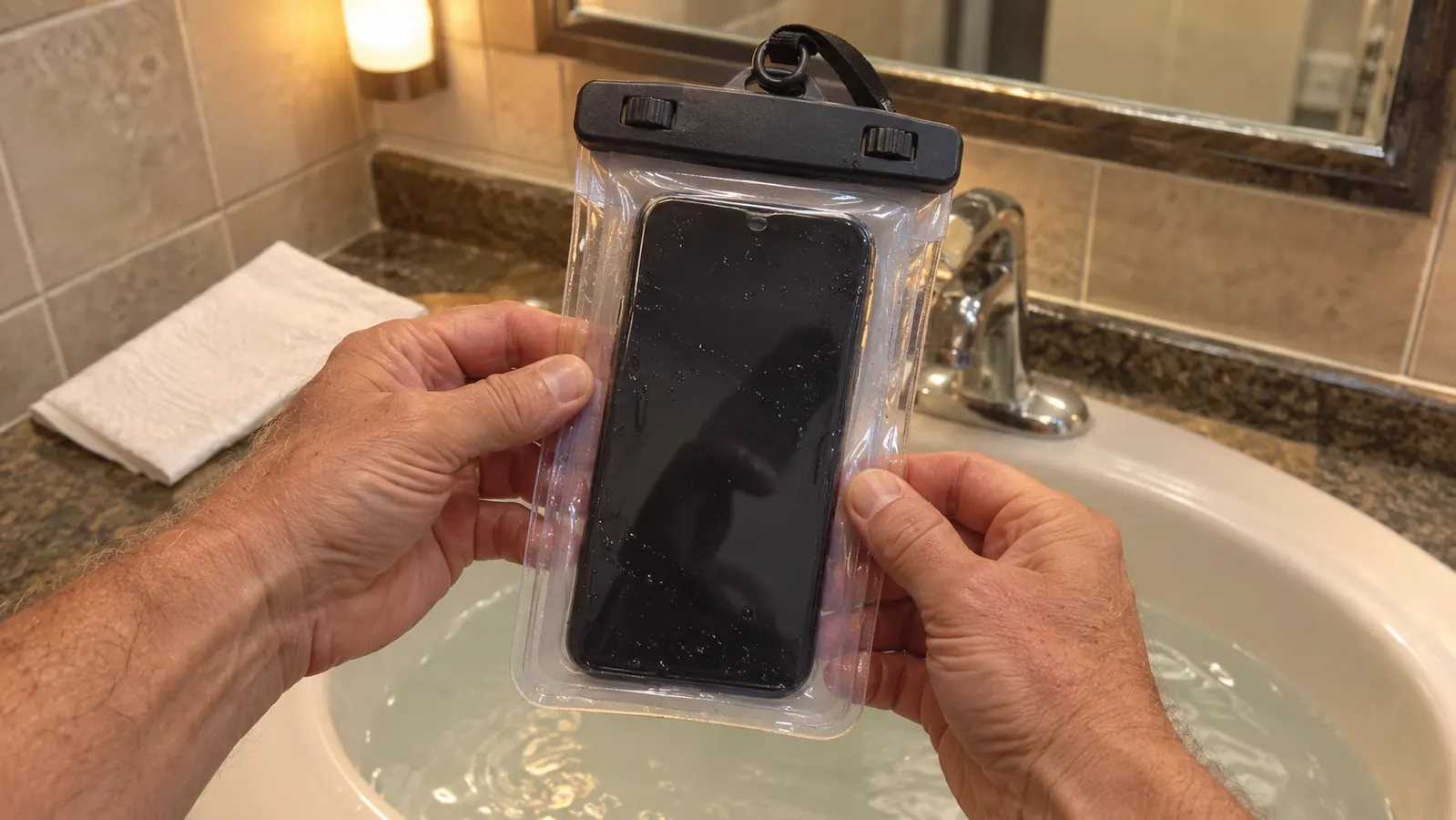
The morning before we leave, I fill the bathroom sink with about three inches of water, fold a paper towel into quarters, put it in the pouch, and seal it. Then I lay the pouch flat in the water, press the air out from the bottom, and leave it there for five minutes while I water the plants and think about whether I packed the sunscreen. Paper towel dry means the seal is sound. Paper towel damp means the pouch goes in the bin and I take the spare.
I made this a step instead of a habit for a reason. A woman in the cabin next to us on our twelfth cruise mentioned that her pouch had been living in a drawer since before the pandemic, and the plastic along the seal had stiffened enough that the two rails no longer sat flush. It might have held. It might not have. Five minutes at the kitchen sink answers the question in a way that a shrug does not.
Do the test with the phone out of the pouch. That sounds obvious. On a snorkel boat in Cozumel I watched a man seal his phone inside first, then dunk the whole bag to see how it did, and I have rarely moved across a deck that fast. He got lucky. Lucky is not a packing strategy.
Step 2: Load It Dry, and Load It Right
Dry hands, dry phone, dry inside of the pouch. If you have been in the water and want to put the phone back in, dry both first, using the cloth that came with the pouch or the hem of your shirt. Salt crystals are tiny and they sit right on the seal rails, and one grain of sand in the wrong place is all it takes. I keep the dry wipe that came with the pouch in the drawer with my sunglasses, and I run it around the inside of the window before the phone goes in. A fingerprint on the inside of that window stays there for the whole trip, magnified, in the corner of every photo you take.
Push the phone down so it sits under the clear window rather than floating up at the top. On this pouch the window is 3.2 by 6.37 inches and the whole case takes devices up to 3.35 by 6.69 inches, so a large phone in a chunky case is going to be tight. I take my case off. Gus leaves his slim case on and his still fits, but his phone is smaller than mine and he does not have a pop socket stuck to the back of it. The first time I loaded mine I pushed too hard and the phone slid up past the window, so the top inch of the screen was looking through the sealed seam instead of the clear panel. Nothing leaked. I just could not read the top of anything until I opened it and repositioned. Push it down gently and check that the whole screen sits behind the clear plastic.
Then close the snap and run your thumb along both rails of the lock. You should feel them seat. If the rails do not line up flush, open it, straighten the plastic, and start again. This is the part that fails, not the window and not the strap. Get the seal right and the rest of the pouch will do its job.
Step 3: Wear It Inside Your Shirt, Not Outside It
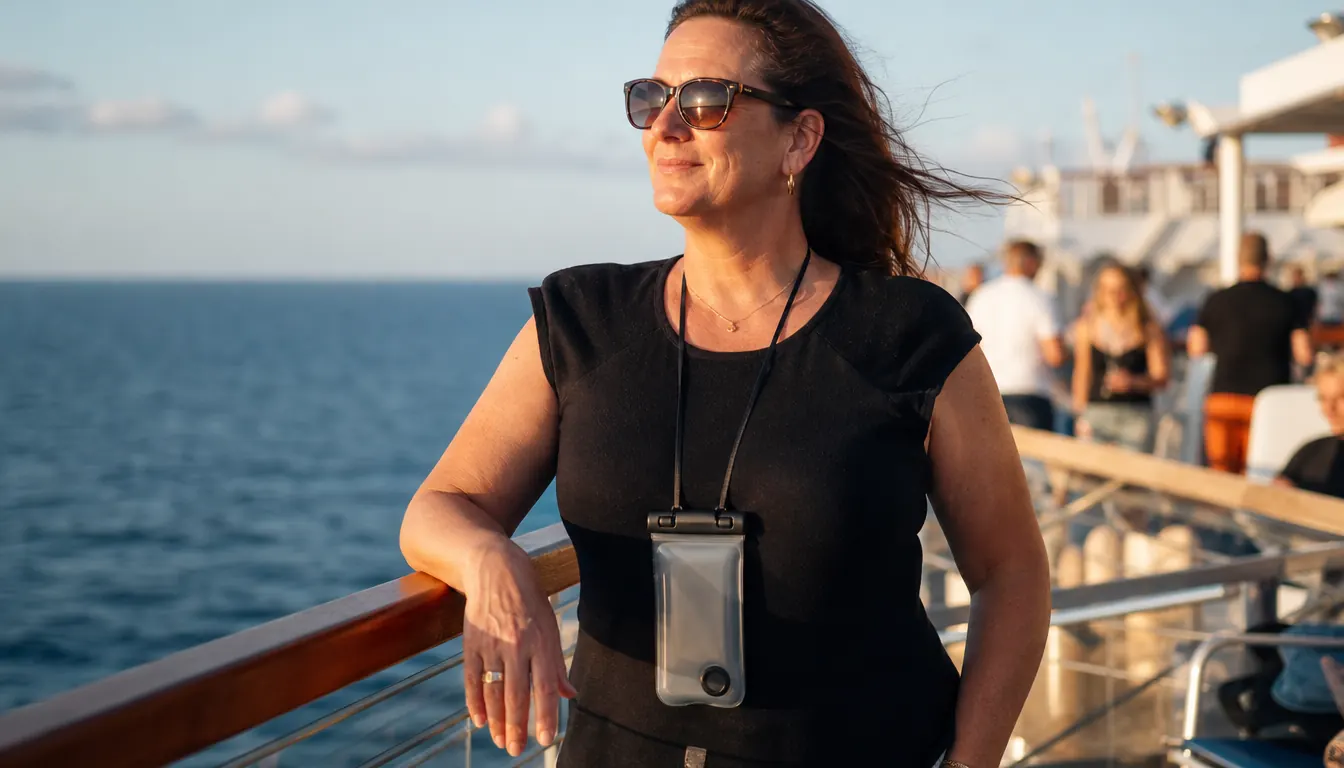
The neck strap is the reason I stopped worrying about the phone. On a catamaran out of Cozumel I wore the pouch under my rash guard while I snorkeled, and it stayed flat against my chest, out of the way of my arms and out of the way of the ladder. When I wanted a photo I pulled it up by the strap, shot through the window, and tucked it back under.
Worn outside a shirt, the pouch swings. It swings into the ladder rails at the pool. It swings when you lean over a railing to look at a pilot boat. On a windy top deck it swings like a pendulum, and sooner or later it catches on something. Under a shirt or a rash guard it does none of that, and the strap stays where you put it. On our Nassau day the tender in was choppy enough that the woman across from me had to hold her phone against the rail with her chin while she grabbed the handhold with both hands. Mine was under my shirt. I had two hands free and nothing to think about, which is the whole argument for the strap in one boat ride.
On port days I wear it the same way, under my shirt, with my ship card in the other pocket of my shorts. That means both hands are free on a tender, at a market stall, and on the stairs down to the pier, which is where I have watched more than one phone go bouncing. It also means I do not think about it again until I need it.
Two pouches, four sailings, one paper-towel test at the bathroom sink before every trip, and neither phone has come out wet.
Step 4: Use It Through the Window, Then Put It Away
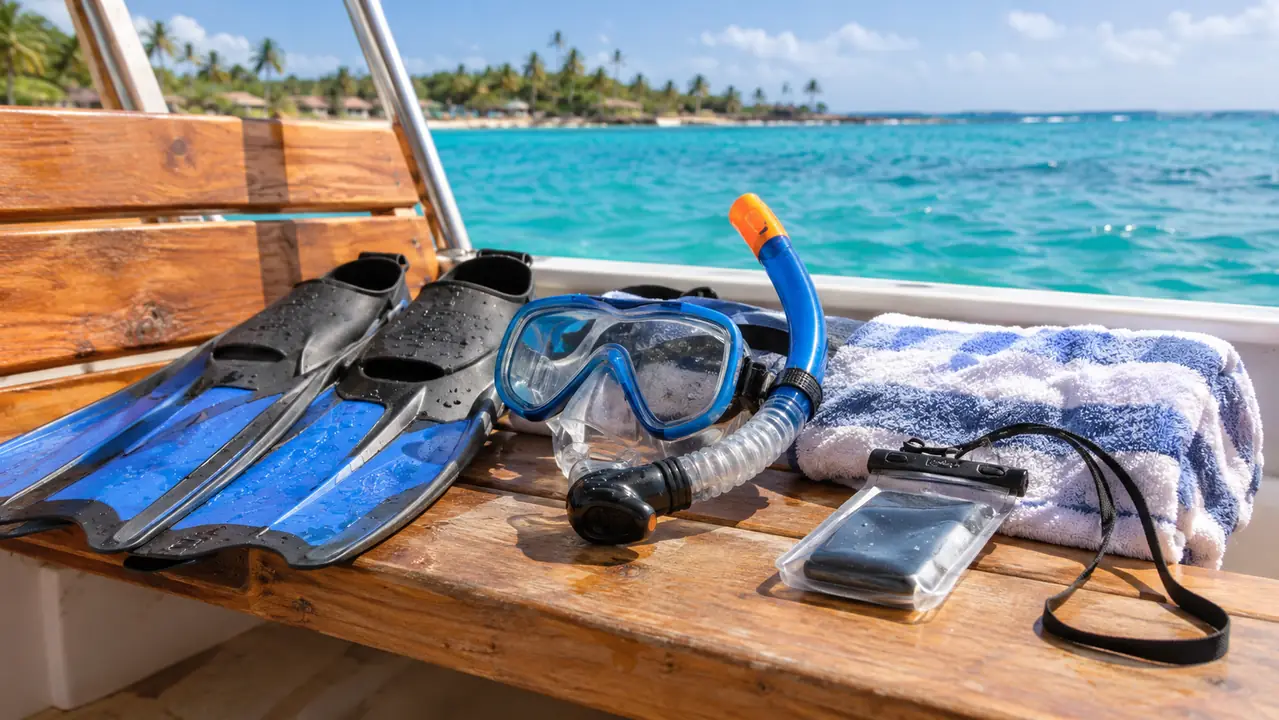
The touchscreen works through the plastic. Not perfectly, but well enough to text Gus that I am on my way back to the cabin, and well enough to take a photo of the ship from the tender. The camera shoots through the window fine in good light. Underwater you get about as far as the length of your arm and the colours go flat, which is a camera problem and not a pouch problem. On the sea day I took about forty photos through that window and kept six. The ones that worked were shot with the sun behind me and the pouch held flat against my palm, not tilted up at the sky. Tilt it and the plastic catches the glare and you get a bright smear where the ship used to be.
What the pouch will not survive is being left in the sun. On the pool deck I keep it under a towel or zipped in the tote, because heat is the other thing that kills phones, and a sealed bag in direct afternoon sun is a small oven. I treat the JOTO pouch the same on the drive to Port Canaveral and do not leave it on the dashboard while we park.
One habit that helps: dry your hands before you open the pouch, not after. Opening it wet is how water gets inside, and it is the one mistake that no amount of testing beforehand will save you from. Gus learned that the ordinary way, and his phone spent a night in a bag of rice on our eleventh cruise. It recovered. Barely.
Step 5: Rinse It in Fresh Water, Then Let It Air Out Open
After a saltwater day I rinse the closed JOTO pouch under the tap in the cabin bathroom, dry the outside with a towel, open it, and set it on the desk to air out overnight. Salt left sitting on the seal will chew it up over a season, and the inside gets humid from the phone itself. Ten seconds of rinsing is the difference between a pouch that lasts four sailings and one that lasts one.
The pouch came with a wet wipe, a dry wipe, and a screen protector, which is more than I expected from a bag. I use the dry wipe on the window, because a smeared window makes every photo look like it was taken through a shower curtain, and I keep the wet wipe in my tote for sunscreen hands. The screen protector went on once and came back off, since the pouch window already does that job.
On the last morning I open the pouch, check the rails for grit, and pack it flat in the front pocket of my carry-on tote. It does not go in the checked spinner, where a suitcase corner can press on it for six hours in a hot hold. Ours have come through four sailings that way and they are still the two we take.
What Else Helps
The pouch solves one problem. Two other things in the cabin make it easier to live with. The first is a pair of magnetic hooks on the wall by the desk, which is where the pouch hangs to dry instead of getting draped over the television. The walls on most ships are metal, so the hooks stick, and ours have stayed put through six sailings without leaving a mark. The pouch hangs from the hook nearest the bathroom door, at about eye level, seal open and window facing out, and it is dry by morning. That hook also holds Gus's hat, which is how I know he has been up on deck before me.
The second is a small non-surge power strip on the desk. A cabin usually has one outlet at the desk and maybe one more by the bed, which is not enough for two phones, an e-reader, and a razor overnight. Check your cruise line's rules before you pack one, and never plug a heating appliance into it, because those are banned on board and security will take them at embarkation.
If you want the longer version of how the pouch itself has held up, there is a full write-up of its four seasons of use on the site, plus a side-by-side with a hard waterproof case for anyone who wants to take photos underwater rather than just keep a phone dry at the pool. The short version is that the soft pouch wins on portability and the hard case wins on drop protection, and I carry the soft one because I am not dropping my phone, I am splashing it.
Test it at the sink, wear it inside your shirt, rinse it at night
Four sailings in, the JOTO pouch is the one item in my tote that I check twice before we leave the house. It fits phones up to 7 inches, it is IPX8 rated to 100 feet, and it comes with a neck strap, a wet wipe and a dry wipe. Do the paper-towel test first and it will outlast your phone.
Amazon Check Today's Price on Amazon →