
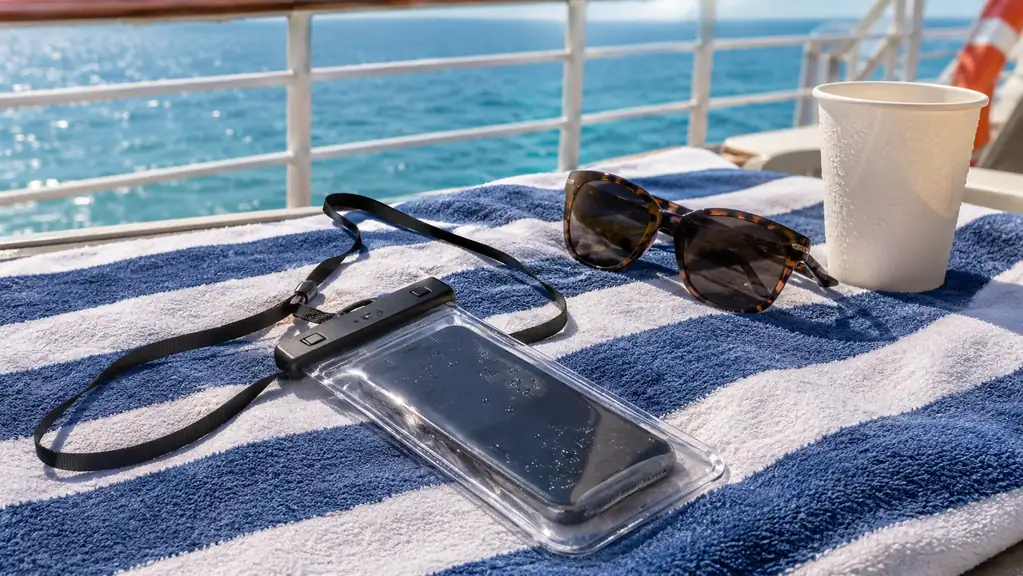
The first honest thing I can tell you about the JOTO waterproof phone pouch is that it does not make your phone waterproof. It makes your phone a phone inside a sealed bag, and that is a different thing with different rules. I bought two before our 11th cruise out of Port Canaveral, one for me and one for Gus, and we have used them on four sailings since: pool deck mornings, a catamaran snorkel out of Cozumel, and one memorably wet tender ride into a port with no dock. Neither phone has ever taken on water. Both of us have been mildly irritated by the same handful of things I am about to describe.
So this is the version of the review I wish had existed before I clicked buy. Not whether it works. It works. What it is like once the novelty wears off and it is just another item riding around in the embarkation tote next to the sunscreen.
The Quick Verdict
Four sailings, zero leaks, and a camera that takes soft photos through plastic. It earns its spot in the tote, as long as you know exactly what you are getting.
Amazon Check Today's Price →Four cruises in and the seal has never failed. Here is today's price.
Two of these live in the front pocket of my carry-on tote now. A two-minute paper towel test before every trip, and it has come out dry every time.
Amazon Check Today's Price on Amazon →How I've Actually Used It
The routine has not changed since the first trip. The pouches live in the front pocket of my carry-on tote, folded flat, one in each zip section so we are not hunting for them on the first sea day. On a port day they come out at breakfast and go around our necks before we leave the cabin, because the one afternoon I left mine behind, I spent four hours keeping my phone in my sun hat.
The test comes first. Every single trip, in the bathroom at home before we drive to the port, I fold a paper towel into the pouch, run my thumb along both sides of the closure, and hold the whole thing under the running tap for a full minute. Then I open it and check the paper. In four years of doing that, the paper has come out dry every time. I do it anyway. A sealed bag you have not tested is just a bag.
The tender ride was the day I stopped thinking of it as a pool accessory. Grand Cayman has no dock for the big ships, so everyone queues in the stairwell and boards a little boat that takes about twenty minutes to reach the pier. The sea was up that morning. We sat on the open bench at the back because the cabin was full, and by the time we tied up my shorts were soaked through and my tote had a puddle in the bottom of it. I unzipped the pouch expecting the worst. The seal held. The phone was dry, the screen lit up, and I had a photo of the harbour taken from the water that I would never have risked otherwise. That twenty minutes is the reason the pouch goes on every trip now, not the swimming.
In use it is simpler than I expected. Gus takes his down the pool slide with him, which the lifeguards have never objected to. I wear mine around my neck on the snorkel boat and leave it there while I am in the water, mostly so the phone is not sitting unattended on a bench while forty strangers walk past. It is not a camera housing. It is a place to keep a phone that is not a beach towel, and once I stopped expecting more than that, I stopped being disappointed.
Gus uses his differently from me. He keeps it on even on sea days, mostly because he put a phone in a hot tub exactly once and has not stopped hearing about it. On port days it rides in the mesh pocket of his day bag. He has never complained about it, which from Gus is a review of its own.
What Nobody Tells You About the Touchscreen
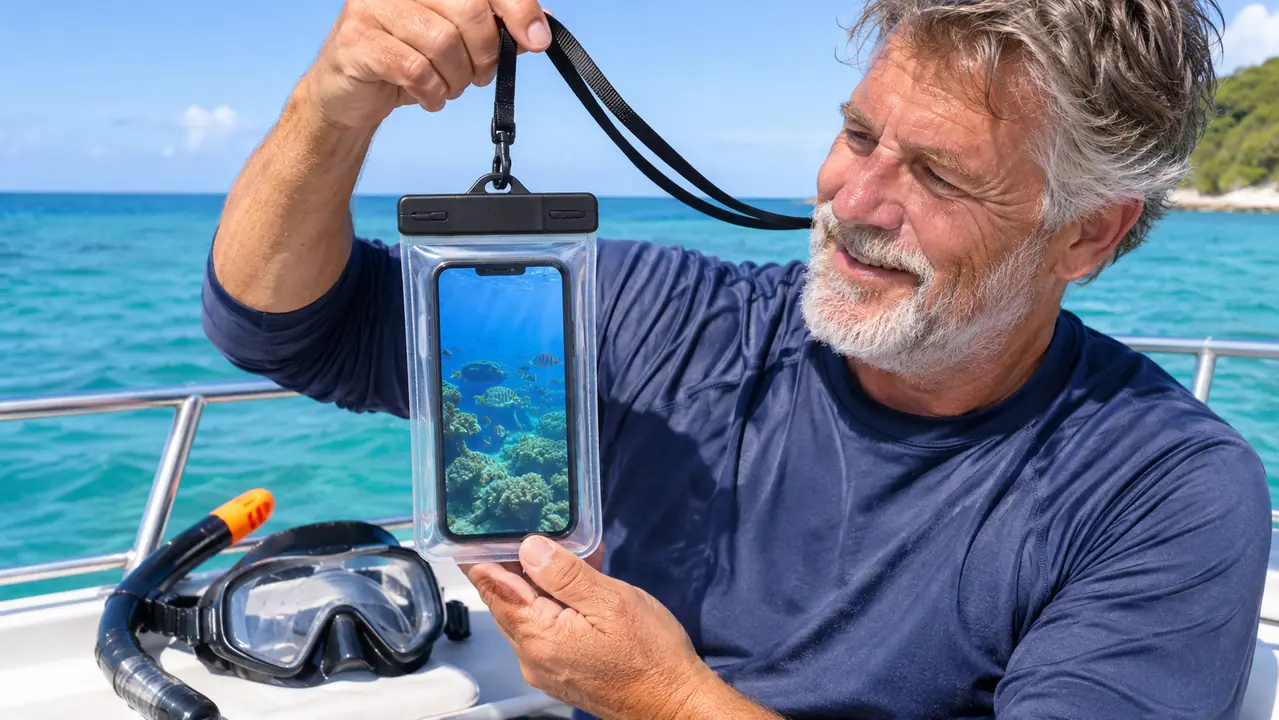
The touchscreen works. That is the sentence everyone wants, and it is true. The catch is the word works. Through the clear window you can tap, scroll, enter a passcode, and take a photo. What you cannot do is type comfortably. Wet fingers on plastic are a mess, and even dry fingers miss letters they would hit on bare glass. If you plan to answer messages from the pool, plan again.
Face unlock does not read through the plastic, on my phone or on the one I carried before it. The passcode works fine, so the practical fix is to slow down and tap six digits with a damp thumb. The other fix is to lift the phone out of the pouch, which on a boat rather defeats the purpose.
Photos are the bigger compromise. They come out slightly soft, like a window that needed cleaning. On a bright day on deck you will not care. At the reef, where the whole point is the fish, you will care. Gus got a few decent shots by holding his phone flat against the window and shooting straight through it, and a lot of mediocre ones at an angle. The pouch is not the reason to bring a phone snorkeling. It is the reason the phone survives being brought.
The reef day in Cozumel is the one I measure everything against now. We booked a catamaran with two snorkel stops and a lunch that was better than it needed to be. I had the pouch around my neck and a simple plan: shoot the fish, come home with something worth showing Gus's brother. What I actually got was forty minutes of holding my phone a foot from the glass while a school of yellowtail drifted past, and about nine usable frames out of maybe sixty. The colours were fine. The edges were not. Anything moving came out as a smear, and the reef itself looked like it was sitting behind a shower curtain. Gus, shooting straight down through the window with the sun behind him, did noticeably better than I did. Neither of us got anything worth printing. We got proof we were there, which is honestly most of what phone photos at a reef are ever going to be.
Condensation is real. Carry the pouch from a cabin that has been cool all night out onto a July deck in the Caribbean and the inside of the window fogs. It clears in a few minutes. It also makes every photo taken during those few minutes look like it was shot through a bathroom mirror. I wipe the inside with the dry cloth that came in the box, which brings me to something else.
One more thing about the window. It is glossy, and in direct Caribbean sun it throws a reflection that makes the screen hard to read even at full brightness. I find myself turning my back to the sun or stepping into the shade of a towel hut to check the time. Small thing. Also the kind of small thing you only learn by using it.
The Annoyances I've Learned to Live With
The case has to come off. The listing says the pouch fits phones up to 7 inches diagonal, with a clear window of 3.2 by 6.37 inches and room for devices up to 3.35 by 6.69 inches. That is accurate and it is also tight. A chunky protective case eats most of the margin. I peel my case off before every trip and leave it in the safe with my earrings. Gus forgot once and spent ten minutes working his phone into the pouch at the airport, which is not something you want to be doing at an airport.
It does not float. Nothing in the listing claims it does, so this is not a broken promise, just a fact worth knowing before you lean over the rail to photograph a turtle. Mine is either on a lanyard around my neck or folded in the tote. It is never loose in my hand over open water.
The lanyard is thin. It is a cord, not a strap, and once the pouch is wet that cord rubs the back of your neck in a way you notice after about an hour. I loop mine through the tote strap on beach days instead of wearing it. Gus does not seem to mind, but Gus also wore the same sun hat for six years.
The closure takes two hands to be sure of. It is a snap and lock track: you press the two sides together and run your thumb along the full length of it. Done properly it is solid. Done one-handed, in a hurry, at the pool, you will spend the next hour wondering whether you actually got the whole length. One afternoon on the pool deck I did exactly that, with a drink in my left hand and the sun in my eyes, and I got about two thirds of the track. I did not notice until I was already standing in the shallow end with the pouch hanging in front of me. I got out, opened it up, and there was a film of water across the inside of the window. The phone was dry, but that film told me precisely how close I had come. I press the track shut on a flat surface now, run my thumb along it twice, and I do not do it while holding anything else. It is a thirty second habit that replaced an hour of worry.
The extras in the box are an afterthought. You get a wet wipe, a dry wipe and a screen protector. The wipes are small and single use. The screen protector is meant for the phone itself and it is fiddly to get on straight. I gave up on mine after the second trip. A small microfiber cloth in the tote does the same job as both wipes and never runs out.
Drying it matters more than I expected. Seal it damp and the inside stays damp until the next time you open it, and then the window is fogged before you have left the cabin. I open mine on the last night, wipe it out, and leave it airing on the desk. Thirty seconds of work, and it is the difference between a pouch that is ready for the next trip and one that smells like a pool.
What I Liked
- Kept two phones dry across four sailings, including snorkeling and a wet tender ride
- Folds flat and weighs 50 grams, so it takes up no room in a carry-on tote
- Sand stays out, which on a beach day matters more than the waterproofing does
- Touchscreen taps, scrolling and passcode entry all work through the window
- The neck strap keeps your hands free on a snorkel boat or at the pool
- The paper towel test takes two minutes and has not failed once
Where It Falls Short
- Photos come out soft through the plastic window
- Face unlock does not read through it, so you type a passcode
- Condensation fogs the window when you move from a cool cabin to a hot deck
- Chunky phone cases have to come off to fit the opening
- The lanyard cord rubs when it is wet
- It does not float, so it stays on a neck or in a bag over water
The pouch has never leaked and it has never taken a photo I would frame. Both of those are true at the same time, and the listing only tells you the first one.
The Things It Genuinely Gets Right
The seal. That is the whole product and the JOTO has held. The listing rates it IPX8 and 100 feet, which is far deeper than anything I will ever do with a phone. My testing stops at snorkel depth and a bathroom sink, and at those depths it has been flawless for four sailings running.
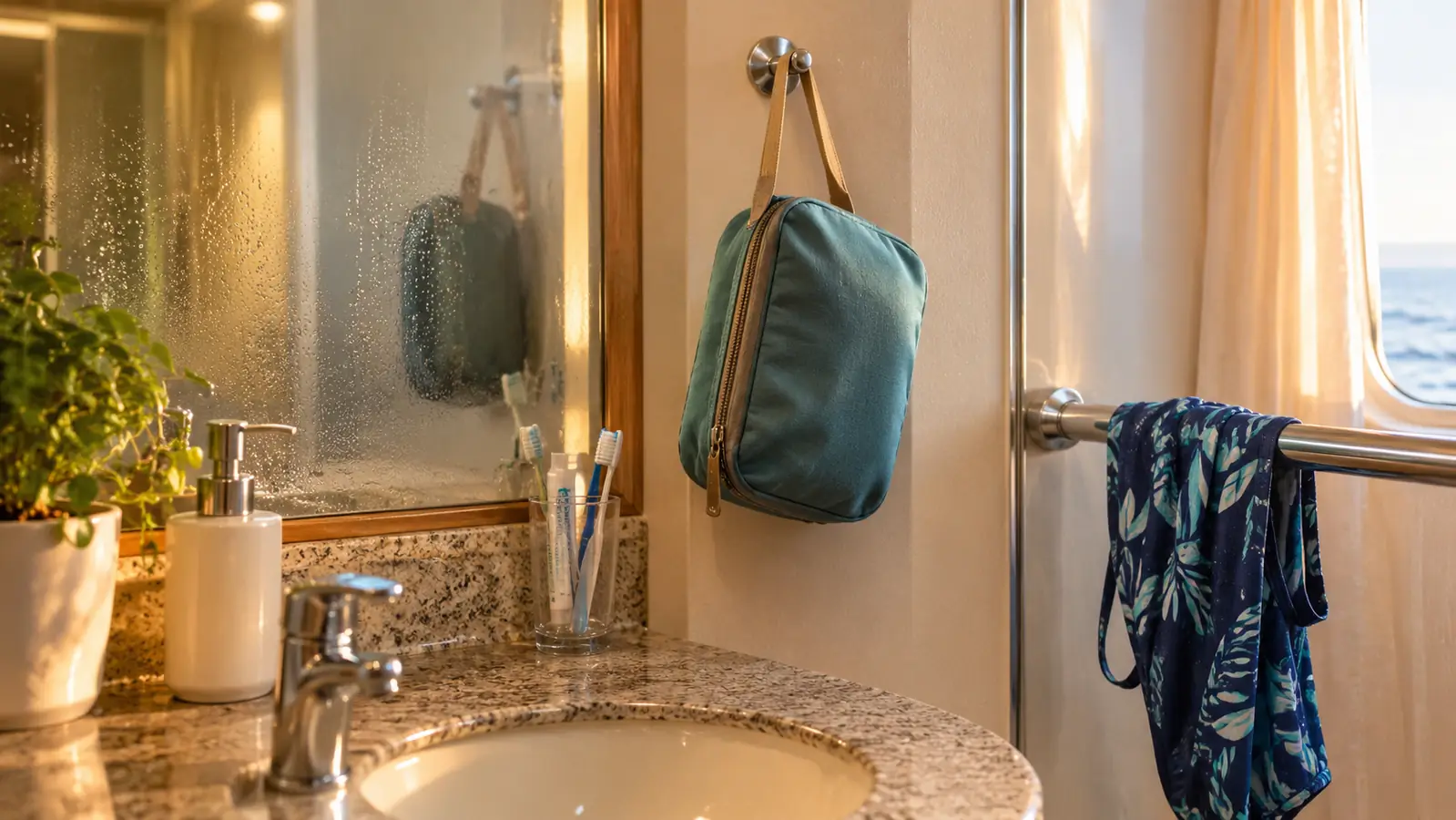
Sand resistance is the benefit I did not expect to care about. The sand day that convinced me was Grand Turk, where the beach runs practically from the end of the pier and the tote came back with a visible layer of grit in the bottom of it. Everything inside needed a rinse that evening: the sunscreen bottle, the cover on my e-reader, the hairbrush, the lotion cap. The phone came out of the pouch clean and dry. The pouch itself rinsed off under the tap in the cabin sink and hung on the back of the bathroom door, and it was dry by dinner. That is the whole story, and it is not dramatic, but a phone that survives a beach day without a grain of sand in the charging port is a phone that still works when you get home. That is the part I care about now.
It folds flat. At 50 grams and folded, it disappears into the front pocket of my tote and I forget it exists until an island shows up on the horizon. Anything that earns a permanent spot in a carry-on has to be small or useful. This one manages both.
The neck strap is the part I use most. Not for swimming, for the walk from the cabin to the pool deck when I have a towel in one hand and a drink in the other. It hangs at chest height, I forget about it, and it is not sitting on a lounger where anyone could pick it up. On a ship, that is most of the value.
And it removed a small worry. Before the pouches, one of us was always the designated phone watcher, sitting with the tote while the other one swam. Now we both get in the water. That is worth more than the pouch's share of the suitcase.
Who This Is For
You will get on well with it if you want your phone dry and your hands free at a pool or on a beach, and you are content to take ordinary photos through a window. It suits people who carry a phone in a bag or around their neck all day and only take it out for a quick shot or a message. It suits anyone traveling with a partner and no interest in taking turns guarding a tote. If you want the year-by-year version of these same notes, I wrote up the JOTO waterproof phone pouch long-term review separately, and it covers the wear after several more trips.
Who Should Skip It
Skip it if you want underwater photographs that look like underwater photographs. The plastic window is the limiting factor and no technique gets around it. Skip it if your phone lives in a thick case and you are not willing to peel that case off before every beach day. Skip it if you want a case you can drop in the pool and forget about, because this one needs a lanyard or a pocket. And skip it if you want a hard shell that shrugs off drops, which is a different product doing a different job. If that is you, start with my JOTO vs a rigid waterproof phone case comparison, where I lay out what each one is actually good at.
Two phones, four cruises, no water inside either one.
Ours have lived in the tote since the 11th sailing and they still seal on the first press. Check today's price on Amazon before your next embarkation day.
Amazon Check Today's Price on Amazon →